Phone:
+86 15005422253
Physical address:
Pingdu City, Qingdao,
Shandong Province, China.

Phone:
+86 15005422253
Physical address:
Pingdu City, Qingdao,
Shandong Province, China.
Choose a stainless steel investment casting manufacturer by reviewing alloy fit, wax tooling, corrosion environment, machining, finish, inspection and documents.
An investment casting manufacturer is only as good as the last X-ray it ships. With stainless steel, that is not a slogan. It is the whole job. Stainless pours hot, shrinks, and hides internal defects where you can’t see them. If the foundry doesn’t control wax, shell, melting, and cooling, your drawing is just a wish.
Before the process talk, a warning about the market. The sector is full of trading companies that take your drawing, subcontract the casting, and mark it up. They aren’t all bad. But they add a layer between you and the people actually pouring metal. So verify the basics on any shortlist: a real plant, a real quality lab, and current certifications like ISO 9001 and IATF 16949. Waking says it plainly on its own site: a real casting factory, not a trading company. Make that the minimum bar, not the selling point.
This guide comes from the foundry side of the table. We operate a 70,000 m² plant in Qingdao with 400+ CNC machines and in-house inspection equipment. Take the opinions as supplier opinions — then test them on the next foundry you visit.
Investment casting — lost wax casting — gives you near-net shapes: thin walls, complex internal passages, and a surface that needs far less machining than sand or permanent mold casting. For stainless steel, that geometry is usually the reason the process gets chosen at all.
But stainless steel punishes sloppy process control harder than carbon steel does. It solidifies over a wide temperature range, which widens the zone where shrinkage porosity forms. Heavy sections cool last and act like magnets for defects. That is how a casting that looked great in the first article ends up leaking in service.
One technical point worth asking about directly: which shell system does the foundry use? Silica sol is the investment casting route that holds tolerance and surface quality. The cheaper water-glass route is still around, mostly because it costs less. The difference shows up in machining time and scrap rates. We run silica sol on our lines.
That is not an abstract warning. That is why serious foundries own X-ray equipment. The buyer can’t see inside a casting. The foundry’s inspection capability is your visibility.
Most drawings arrive with a callout like 304 or 316. Those are wrought grades — the designations used for plate, bar, and tube. In investment casting, the same material families appear as CF8 and CF8M. CF8 is the cast counterpart of 304. CF8M is the cast counterpart of 316. When a foundry quotes CF8 against your 304 print, that is standard casting practice, not a substitution trick.
What should change your buying decision is what the certificate says. Compare the chemistry ranges, mechanical properties, and heat treatment against your print. Confirm the foundry issues a material certificate with every lot and attaches the inspection report. That traceability is not paperwork theater. It’s how you prove, after a field failure, that the material was what you specified and the treatment was what you paid for.
These four grades — 304, 316, CF8, CF8M — carry a lot of the world’s pump and valve castings. Valve bodies, impellers, and housings are built this way because investment casting handles the geometry and the pressure requirement at the same time. The casting’s soundness is what lets them hold that pressure. That brings us to inspection.
Every foundry claims quality. Few can show you the equipment behind the claim. When you qualify a supplier, ask three questions. When they can also show you the machine, the answer is believable.
Can the foundry see inside your casting? Internal porosity and shrinkage don’t surface until machining or pressure testing ruins the part. X-ray NDT catches them first. We screen castings with an XTH320 X-ray system, and a defect found there gets traced back to its lot. If a foundry has no X-ray on site, the buyer is betting on the process instead of checking it.
Can the foundry measure your casting? Investment casting holds good tolerances, but “good” is not a specification. Coordinate measuring machines — we run a COORD3 and a ZEISS SPECTRUM — verify that datum features and complex surfaces match the model. A part that’s out of tolerance doesn’t care how good it looked in the photo.
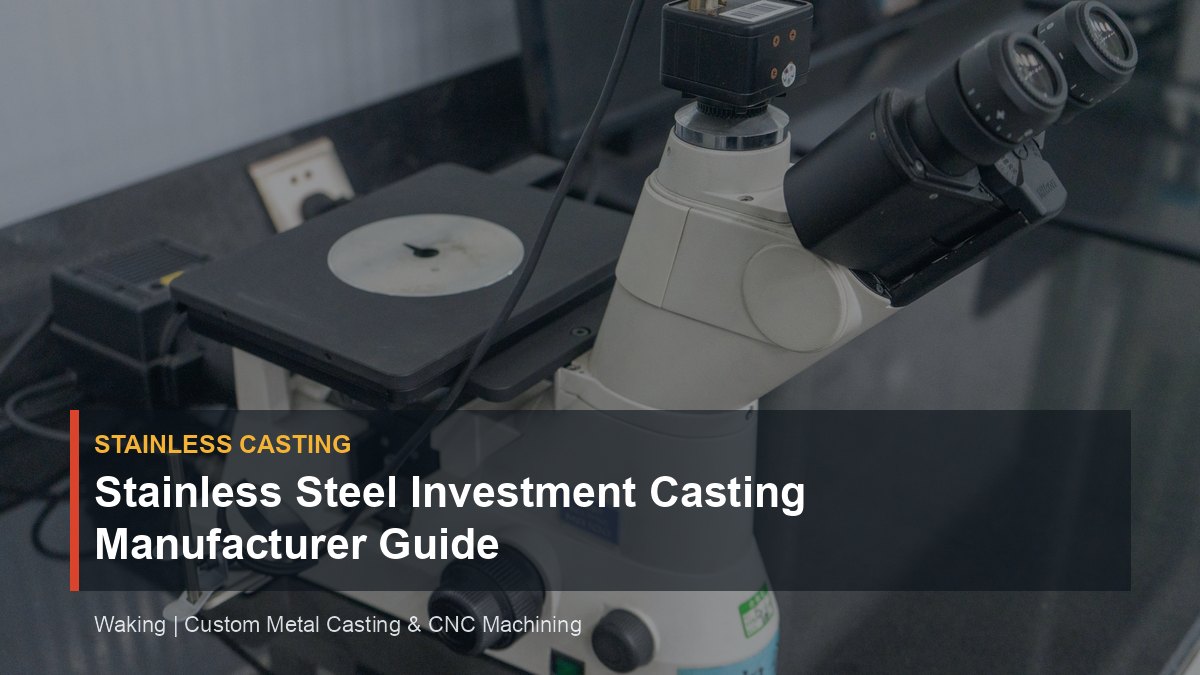
Can the foundry prove the material and the heat treatment? An inverted metallurgical microscope shows whether the grain structure matches the spec — in plain terms, whether the heat treatment actually did its job. A pendulum impact tester, with low-temperature capability, matters for parts in cold service. Hardness testers and roundness and profile instruments close out the dimensional checks.
Then there’s the test buyers forget. If your casting holds pressure, ask whether the foundry leak-tests it. Then confirm first article inspection and sample approval happen before production, and that every lot traces back to its material certificate and inspection report. These aren’t extras. They’re the job.
A casting is a near-net shape, not a finished part. You still need machined faces, sealing surfaces, threads, and mounting holes. At that point, one decision controls your risk: does the foundry machine in-house, or ship the castings to a third-party shop?
The outsourced model is common. It means your castings travel between two vendors who don’t fully control each other. Damage happens in transit. Tolerances get reinterpreted when the new shop locates off as-cast surfaces. And when machining finds a casting defect, blame ping-pongs across two companies while your line waits.
We chose the other route deliberately. Over 400 CNC machines sit inside the same 70,000 m² plant as the casting lines. A valve body can be cast, heat treated, machined, passivated, and tested without leaving the site. When a part fails at machining, our engineers walk to the casting bay and fix the problem. They don’t write an email to an outside vendor.
Finishing matters the same way. Deburring, cleaning, polishing, passivation — the steps that keep stainless steel stainless — should be under the same roof or at least under the same traceability. Passivation especially: skip it, and a “stainless” part can start spotting rust within months. That’s not a materials problem. It’s a finishing problem, and it’s avoidable.
The foundry that quotes fast from a photo usually delivers slow — or wrong. Serious suppliers start with an engineering review. At Waking the process runs in three steps: send drawings and requirements, get an engineering review and a quote, then casting, machining, and delivery.
Send the drawing with tolerances and datums. State the material grade — 304, 316, CF8, CF8M, carbon steel, or alloy steel — and the annual quantity, because quantity drives gating, tooling, and pricing. Then tell the foundry what the part actually does. What does it hold? At what pressure and temperature? Is it a valve body, an automotive housing, or an industrial machinery part? A foundry can’t design a sound casting in a vacuum.
Expect pushback. A supplier who suggests a larger radius here or a more uniform section there is not being difficult. They are preventing a defect you would otherwise pay for. If your supplier never challenges your drawing, one of you is not paying attention.
On lead time and MOQ, don’t trust fixed numbers on a website. They depend on your geometry, material, quantity, and the foundry’s current schedule. A serious supplier gives you a realistic lead time and a sensible minimum order, quoted against your specific part, in writing. That kind of direct answer is the quickest way to tell a real factory from a go-between.
Choose the foundry that shows you the X-ray equipment, quotes CF8 against your 304 drawing without flinching, and walks you through the inspection report before you ask. That is a stainless steel investment casting manufacturer. The rest is paperwork.