
When you buy investment casting parts, the material certificate is the first document you should look at. A usable certificate tells you three things: the chemical composition of the metal, the mechanical properties it showed in testing, and the heat or batch it came from. Most buyers ask for “a certificate.” The better question is: which certificate, covering what, and traceable to which batch?
What a usable material certificate contains
The composition is the foundation. For stainless steel castings — 304, 316, CF8, CF8M — the certificate should list the element percentages that define the grade. Measure them against the grade you specified, not against what the supplier says is “close enough.” If the numbers sit outside the accepted range, the part isn’t that grade, no matter what the paperwork says. The same logic applies to carbon steel, alloy steel, and aluminum alloy castings.
Mechanical properties matter just as much. Yield strength, tensile strength, elongation, and impact values tell you whether the metal will hold up in service, not just whether it has the right chemistry. If your part is a valve body or a pump component, pay close attention here. A casting that meets composition but fails on elongation can crack in the field.
Then there’s the heat number. Every certificate should state which melt or production batch the material came from. Without a heat number, a certificate is just a description of a similar material. It doesn’t prove your parts were made from it.
Not all certificates are equal, either. Some suppliers send the raw material certificate from the steel mill and stop there. That’s a starting point, not the full picture. What you need is a certificate covering the metal actually poured into your castings, with results tied to your batch. If a supplier can’t explain the difference, treat that as a red flag.
Traceability: the part that gets skipped
A material certificate is only worth something if it links to your actual parts. You should be able to point at a batch of castings and ask: which certificate covers this batch? And the supplier should answer without digging through files for three days.
Traceability is a process, not a folder of documents. The foundry has to keep melt records, keep batches separate on the shop floor, mark parts, and carry the same batch number from melting through inspection to dispatch. That’s how the certificate ends up matching what’s on the pallet.
What to request in practice:
- A batch or heat number on the certificate, the inspection report, and the packing list.
- Marking or tags on the parts that match that number.
- A written statement that the certificate covers the shipped batch, not “equivalent material.”
- Inspection records that carry the same batch number.
If a supplier tells you batch traceability costs extra or takes too long, take it as a warning. A real casting factory treats traceability as standard procedure.
What the foundry should verify on its own floor
Here’s where you separate a real factory from a trading company. A trading company can forward a mill certificate just fine. A factory will also verify the material with its own equipment.
At Waking, the quality department checks material properties directly: a hardness tester, a pendulum impact tester that covers low-temperature impact testing, and an inverted metallurgical microscope for material structure analysis. X-ray NDT on an XTH320 system catches internal defects like porosity and shrinkage. A COORD3 CMM and a ZEISS SPECTRUM CMM handle dimensional verification, with portable measuring arms and roundness and contour profilers backing them up. Every one of those checks feeds the inspection records that go out with the goods.
Why does this matter for a material certificate? Because a certificate describes the metal in theory. The actual casting is proven by inspection. You can have a perfect certificate and still get porosity in a thick section. The foundry’s own verification closes that gap.
For pressure-containing parts — valve bodies, pump housings — also ask how the foundry performs leak or pressure testing. At Waking, leak testing for pressure-containing parts is part of the process. Also ask about first article inspection and sample approval before mass production. If the sample is right and the certificate matches the sample, you have a solid baseline. If the supplier skips that step, production quality is left to chance.
What to put in your RFQ
You don’t get good certificates by accident. You get them by specifying them up front. The time to set documentation requirements is when you send the drawings and requirements, not when the parts are ready to ship.
Add these to your RFQ:
- A material certificate for each batch, stating the exact grade — 304, 316, CF8, CF8M, carbon steel, alloy steel, or aluminum alloy — and its chemical composition.
- Mechanical test results, including impact values where the application calls for them.
- Batch or heat numbers on the certificate, the inspection reports, and the parts.
- Confirmation of heat treatment where relevant.
- Inspection reports from the foundry’s own equipment: hardness, dimensional, X-ray, or leak testing as required.
- First article inspection and sample approval before production.
- A clear statement of what happens if the certificate doesn’t match the specified grade.
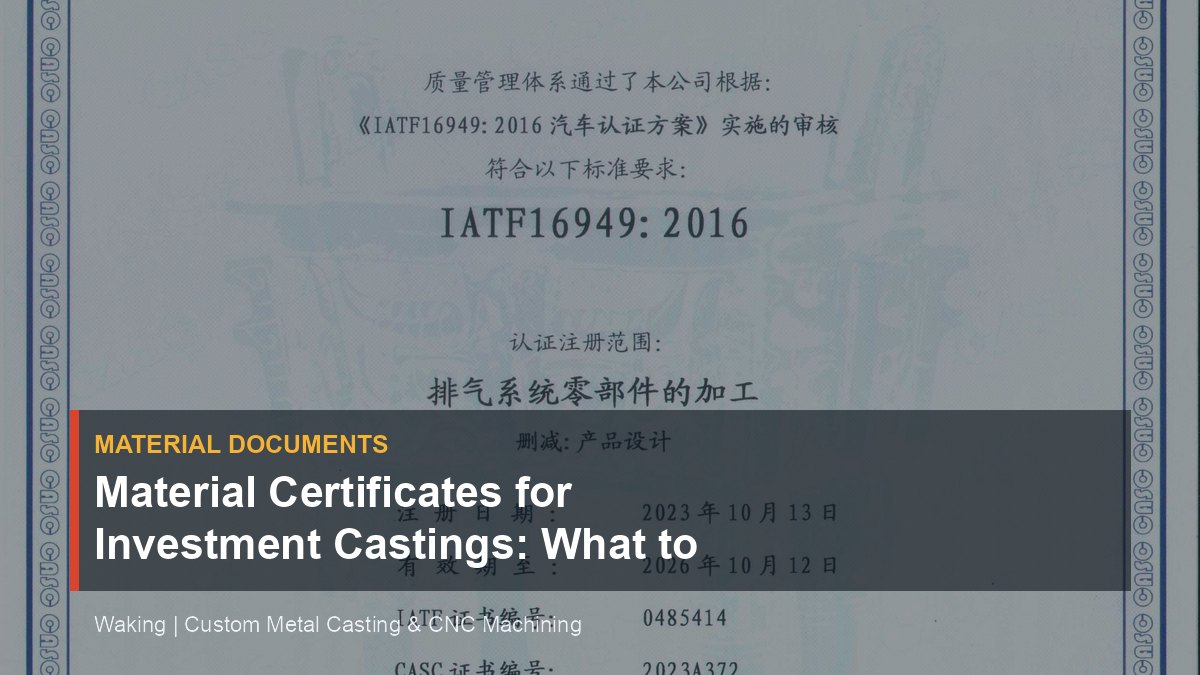
Some suppliers will treat this list as extra work. Good suppliers send it without pushback. A factory running ISO 9001 and IATF 16949 systems, like Waking, should produce these documents as part of the normal flow, not as a special favor.
Take the certificate seriously — but not alone
Let me be blunt: a material certificate is necessary, but it isn’t sufficient. I’ve seen certificates that were technically correct and castings that were still bad. Porosity, cracks, and wrong heat treatment don’t show up on a composition sheet. Treat the certificate as one layer in a larger quality picture.
The larger picture includes the foundry’s inspection equipment, its process controls, its quality management system, and its willingness to answer questions. A supplier that is open about its procedures tells you more than a stack of certificates ever will.
Waking has been doing this since 2002, from a 70,000 m² production base in Qingdao, exporting to more than 40 regions. We are a factory, not a trading company: investment casting, low pressure aluminum casting, gravity aluminum casting, and CNC machining all in-house. Send your drawings and requirements, and our engineering review and quote will cover the documentation you need. A realistic lead time and a quick response to drawings and quotations are standard here.
Here’s your practical test: ask your supplier for a material certificate with full traceability, and inspect what comes back. The suppliers who answer clearly are worth keeping. The ones who hesitate — now you know.
Frequently Asked Questions
What is the difference between a raw material certificate from the steel mill and a certificate that covers my actual castings?
A mill certificate only describes the raw metal before casting; it does not prove your parts were poured from that heat. A usable certificate for your castings must state the heat or batch number and tie composition and mechanical results to the batch you received. It should be supported by matching inspection records and marking or tags on the parts.
Which mechanical properties should I request for investment cast stainless steel components like valve bodies or pump parts?
Request yield strength, tensile strength, elongation, and impact values where the application calls for them. For pressure-containing parts such as valve bodies, pay close attention to elongation and impact performance, because a part can meet composition but still crack in service if elongation is low. The certificate should list measured results for the batch, not just the grade definition.
How can I verify that a material certificate is traceable to the specific batch of castings I receive?
Check that the same batch or heat number appears on the certificate, the inspection report, and the packing list. The parts themselves should carry matching marking or tags, and the supplier should provide a written statement that the certificate covers the shipped batch rather than equivalent material. If the foundry cannot show this link quickly, treat it as a traceability red flag.
What in-house inspection should a foundry perform to back up the claims on a material certificate?
A serious foundry verifies the metal and castings with its own equipment, not just by forwarding a mill certificate. For example, hardness testers, pendulum impact testers, inverted metallurgical microscopes, X-ray NDT systems, and CMMs can check mechanical properties, internal defects, and dimensions. Leak testing for pressure-containing parts and first article inspection before production also help confirm the actual casting matches the certificate.
Key Parameters at a Glance
| Requirement | What to specify or verify |
|---|---|
| Material grade and chemical composition | Exact grade: 304, 316, CF8, CF8M, carbon steel, alloy steel, or aluminum alloy; element percentages against the specified grade |
| Mechanical test results | Yield strength, tensile strength, elongation, and impact values where the application calls for them |
| Batch/heat number traceability | Heat number on certificate, inspection reports, and packing list; matching marking or tags on parts |
| Heat treatment confirmation | Confirmation of heat treatment where relevant |
| In-house inspection records | Hardness, dimensional, X-ray, or leak testing as required; records carried by the same batch number |
| First article inspection and sample approval | FAI and sample approval before production, with the certificate matching the approved sample |
| Nonconformance handling | Written statement of what happens if the certificate does not match the specified grade |
