
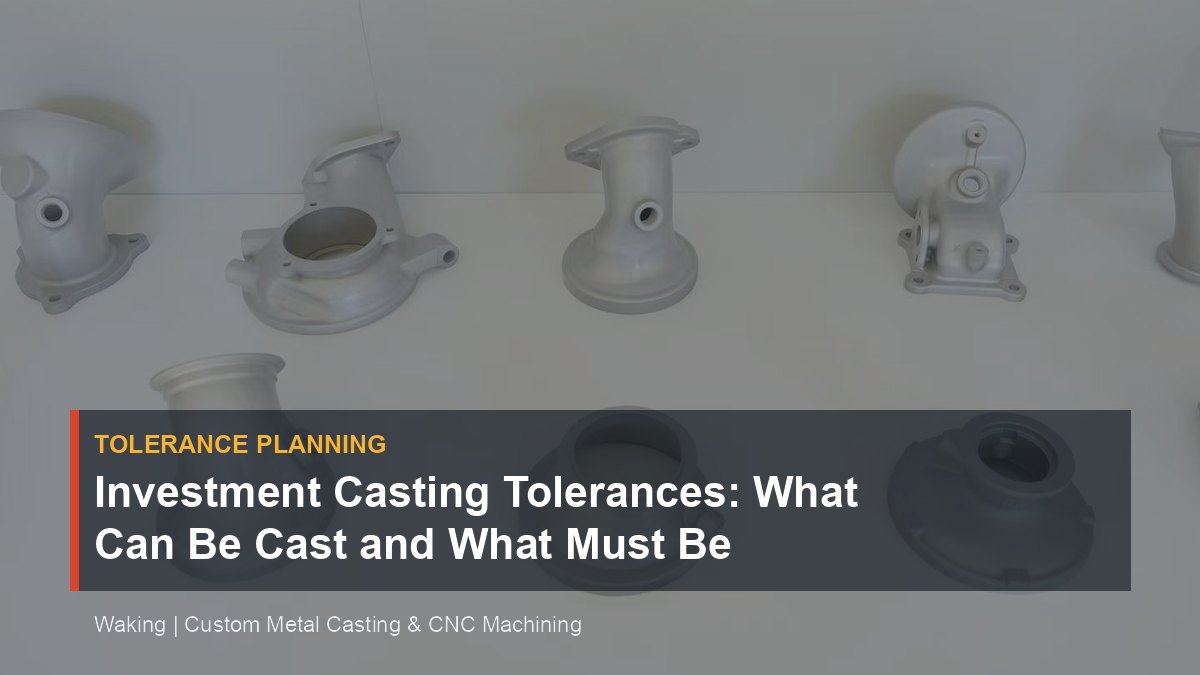
Before a casting quotation means anything, you have to separate the dimensions a foundry can hold in wax and metal from the ones that need a cutting tool. Investment casting tolerances are tighter than sand casting tolerances, but they are still casting tolerances. They are not machining tolerances. Get that distinction wrong, and you will spend the whole project chasing a callout that should never have been put on a cast feature.
Tolerances are easier to hold when casting and machining sit in the same plant. Waking’s CNC machined castings page shows how that flow works.
Why Casting Tolerances Are Not Machining Tolerances
An investment casting starts as a wax pattern, gets coated in ceramic shell, and then the wax is melted out. Molten metal fills the cavity and cools. Every one of those steps moves the final part a little: tooling wear on the wax pattern, shell expansion, alloy shrinkage, and distortion during cooling and heat treatment. The finished dimension is never exactly the number on the drawing. The question is how much spread you can live with.
The tolerance a foundry can hold on a given feature depends on the geometry, the alloy, and where the feature sits relative to the parting line or an internal core. A short, simple dimension between two free surfaces behaves well. A long dimension across the parting line behaves worse. A dimension that depends on a core moving correctly behaves worse again.
Alloy choice matters just as much. Stainless steel, carbon steel, alloy steel, and aluminum all behave differently as they cool. Waking’s investment casting line runs stainless steels in 304, 316, CF8, and CF8M, plus carbon and alloy steels. Aluminum alloys are cast on dedicated low pressure and gravity lines. Each material family gets its own tolerance logic at the engineering review. If a supplier quotes one flat tolerance for the whole part without looking at the geometry, treat the quote with suspicion.
Surface finish matters too. An as-cast surface is functional, but it is not a machined surface. If you try to measure a tight dimension from a rough cast surface, the measurement itself becomes unreliable. Leave the fine finishes to the cutting tool.
Here is the practical takeaway: cast tolerances are held in small increments, but they are not CNC increments. On a feature that has to mate with another machined part, you do not want to rely on luck.
What the Investment Casting Process Holds Naturally
Investment casting exists to make shapes that are expensive or impossible to machine. If you can machine it cheaply from bar stock, you probably should. If it has an awkward contour, an undercut, or an internal passage, investment casting is often the smarter starting point.
A valve body with an internal flow path is a good example. Starting from solid stock, you would spend hours machining the waterway, and the cutters would struggle with the corners. Cast the body, machine the flanges and sealing seats, and you have a part that costs a fraction of the fully machined version.
Typical candidates for as-cast surfaces:
- Complex external profiles and contoured surfaces that need no tight mating fit.
- Internal flow passages, like the waterways in valve bodies and impellers. Cast the passage and let machining handle only the inlet and outlet faces.
- Thin walls and ribbed structures where the shape does the work and the surface is not a sealing or bearing face.
- Identification marks, logos, and part numbers. Casting them in costs nothing extra and removes a marking operation later.
- Holes and slot openings that follow the part geometry, where depth stays modest and the tolerance is functional rather than precision.
A note on internal soundness: the reason you can leave a feature as-cast is that the metal inside it is sound. That is not visible from the outside. For structural and pressure parts, Waking screens for internal porosity and shrinkage with X-ray NDT on an XTH320 system. Sound castings are the only ones that deserve machining time.
What Should Be Machined, No Arguments
Some features are simply not worth trying to cast to tolerance. Machining them is faster, cheaper, and more dependable than asking the casting process to be something it is not.
- Threads. Cast threads are rarely acceptable on structural or pressure parts. Machine them.
- Sealing faces. Gasket faces, valve seats, and O-ring grooves need flatness and surface finish that a cast skin cannot guarantee.
- Precision bores. Bores for shafts and bearings need controlled size and roundness that come from a cutting tool, not from a core.
- Concentricity between two machined features. You cannot hold tight run-out between a bore and a register if one of them is a cast surface. Machine both in the same setup.
- Datums. If a later operation needs a reliable locating surface, machine the datum first. Otherwise the machinist is locating off a cast surface that is never quite where the model says it is.
- Deep small holes. Cores get fragile as depth increases relative to diameter. Drilling is the practical answer.
For pressure-containing parts, the rule is even simpler. The casting gives you the body and the flow path. Machining gives you the surfaces that actually make the seal. Waking leak tests pressure-containing parts, and that test is the moment of truth. If the sealing faces are machined properly, the test is a formality. If they are not, no amount of polishing will save the part.
Why In-House Machining Changes the Tolerance Game
Here is where a lot of buyers get burned. They order a casting from a foundry, then send it to a separate machine shop. The foundry says the dimension is within casting tolerance. The machine shop says it cannot hold the datum because the casting is off. Both are right, and you are stuck in the middle.
The fix is to buy from a factory that does both steps under one roof. Waking is a real casting factory, not a trading company. It runs more than 400 CNC machines in-house, so casting and machining happen in the same plant under one quality system certified to ISO 9001 and IATF 16949. The machinist does not have to guess where the cast surface actually is. The casting engineers and CNC programmers work from the same drawing, the same review, and the same traceability batch.
That setup changes what the inspection can prove. Waking verifies machined features on COORD3 and ZEISS SPECTRUM coordinate measuring machines, runs first article inspection on the first samples, and completes sample approval before production. Material certificates and inspection reports come with the batch traceability. When a buyer asks for proof on a tight dimension, the answer is a CMM report, not a conversation.
The cost angle matters just as much. Every machined surface adds time and material removal. The smart approach is to leave surfaces as-cast where the function allows it and machine only what the assembly, the seal, or the fit requires. A good supplier will tell you which surfaces actually need machining instead of letting you pay for a fully machined part that a minimally machined casting would have handled.
Five Questions to Ask Before You Approve a Casting Supplier
Cast versus machined is a decision you should make with the foundry’s engineers, not in isolation. These five questions will get you the information you need:
- Which dimensions on my drawing are as-cast, and which are machined? Ask for a marked-up print. If the supplier cannot do this, they have not thought about your part.
- Which dimensions cross the parting line or rely on an internal core? Those are the ones to relax or relocate.
- What is the datum strategy? Machining needs a reliable locating surface, and that surface has to exist before anything else happens.
- What does the first article report include? It should cover both the cast geometry and the machined features, with CMM results.
- How is internal quality verified? For structural or pressure parts, ask about X-ray inspection for porosity and shrinkage. Then ask how the part is pressure tested.
And one more question worth asking: who pays for scrap when a casting that passed the foundry’s tolerance still cannot be machined? That question settles whether the supplier thinks about the whole part or just the pour.
At Waking, the process starts with your drawings and requirements, moves to an engineering review and quote, and ends with casting, machining, and delivery. The only way to pin down realistic investment casting tolerances for your part is to review it feature by feature. That conversation happens in the engineering review, before any metal is poured. It is the moment to raise every dimension you are not sure about. The buyers who ask early are the ones whose parts land on tolerance. The ones who do not ask are the ones who find out at first article.
Frequently Asked Questions
Which features can be left as-cast on an investment casting?
Complex external profiles, internal flow passages, thin walls and ribbed structures, identification marks or logos, and modest holes or slot openings can typically remain as-cast if they do not require a tight mating fit, sealing face, or bearing surface. For structural or pressure parts, internal soundness should still be verified by X-ray NDT before a feature is left as-cast.
Why do sealing faces and precision bores need to be machined instead of cast?
Sealing faces such as gasket faces, valve seats, and O-ring grooves need flatness and surface finish that a cast skin cannot guarantee. Precision bores for shafts and bearings need controlled size, roundness, and concentricity that come from a cutting tool rather than from a cast surface or core.
Does alloy choice affect the tolerance a foundry can hold?
Yes. Stainless steel, carbon steel, alloy steel, and aluminum cool and shrink differently, so each material family gets its own tolerance logic at engineering review. A supplier that quotes one flat tolerance for the whole part without considering geometry and alloy should be treated with suspicion.
Why is it risky to source castings from one factory and machine them at a separate shop?
The foundry may say a dimension is within casting tolerance while the separate machine shop says it cannot hold the datum because the casting is off. Sourcing casting and machining from one factory, such as Waking with more than 400 in-house CNC machines and one quality system, removes that interface risk and lets the machinist plan around the actual cast surface.
Key Parameters at a Glance
| Factor | Effect on achievable tolerance | Practical implication |
|---|---|---|
| Alloy choice | Stainless steel, carbon steel, alloy steel, and aluminum cool and shrink differently | Each material family needs its own tolerance review; do not accept one flat tolerance for the whole part |
| Feature location vs parting line | Short simple dimensions between free surfaces behave well; long dimensions across the parting line behave worse | Tight tolerances across the parting line are risky and may need machining |
| Core-dependent dimensions | A dimension that depends on an internal core moving correctly behaves worse | Precision bores and concentric features should be machined rather than cast |
| Surface finish | An as-cast surface is not a machined surface, making tight measurements from a rough cast surface unreliable | Leave fine finishes and sealing surfaces to machining |
| Process movement | Wax pattern wear, shell expansion, alloy shrinkage, and distortion move the final dimension | Casting tolerance is a spread, not an exact number; design for the expected spread |
