
A casting supplier that handles pipe fittings well is different from one that mostly produces decorative parts. Pipe fittings carry pressure. They get threaded, welded, clamped, and buried in systems where a hidden void turns into a shutdown. So before you request quotes, check a few specific things: material traceability, process control, machining capability, and leak testing. This guide covers those checks from a foundry floor perspective, so you can separate a real factory from a middleman.
Start with service conditions before you pick a material
Pipe fittings don’t exist in a vacuum. They see a medium, a pressure, a temperature, and a joining method. That combination should drive the material choice, not the other way around.
For corrosive, sanitary, or high-temperature media, stainless steel is the usual answer. Waking works with 304 and 316, plus the cast equivalents CF8 and CF8M. One common mistake is specifying a wrought grade such as 304 on a drawing without stating the intended manufacturing process. Castings have their own grade designations for good reason, and if your fitting gets welded, the carbon level of the grade matters. Raise this with the supplier during the engineering review, because foundries see these mismatches constantly.
Where strength matters more than corrosion resistance, carbon steel and alloy steel are the workhorse options. Where weight is the enemy, think automotive and machinery housings, aluminum alloy produced by low pressure or gravity casting is the practical route. The process matters as much as the metal. Low pressure and gravity casting give you better control over filling and solidification than a simple pour, which directly affects how sound the finished wall of the fitting will be.
Whatever the material, demand traceability. A foundry that can’t link a heat of material to a certificate is gambling with your pressure system. Material certificates and inspection reports should be issued together against the same batch, and they should follow the parts all the way to your receiving dock.
Make sure casting and machining are under one roof
A pipe fitting rarely ships straight from the mold. Threads, sealing faces, bores, and flange faces all need machining. If casting and machining happen in different shops, you own the interface. When a thread is out of position, the foundry blames the machine shop and the machine shop blames the casting. You pay for the argument.
Waking does casting and CNC machining in the same factory. The machining side runs on 400+ CNC machines, and it is in-house, not subcontracted. That changes the quality conversation completely. The same team that controls the casting controls the machined dimensions, and first article inspection is done on the finished part, not just on the raw casting.
Ask every candidate supplier directly: do you own the machining line? If the answer is no, ask how they manage tolerance disputes and who takes responsibility for the final machined dimension. Then ask about finishing. Stainless fittings that have been machined often need deburring, cleaning, and passivation to restore corrosion resistance. Aluminum parts may need anodizing or coating. Waking covers heat treatment, polishing, plating, anodizing, passivation, and coating within the same factory flow, plus export packaging before the parts leave. Every process you have to coordinate with a separate subcontractor is a schedule risk you are accepting.
Pressure integrity separates a fitting foundry from a general one
Porosity and shrinkage are the classic casting defects. In a bracket they’re cosmetic. In a pipe fitting they’re leaks waiting to happen. The foundry’s internal inspection capability tells you how seriously they treat this.
Waking screens castings with X-ray NDT on an XTH320 system, equipment built to detect internal defects like gas holes and shrinkage. For pressure-containing parts, leak testing is written into the quality process. But do not assume every casting supplier does this. Ask directly: is X-ray inspection standard or an extra charge? Is leak testing included, and on what percentage of parts? What acceptance criteria apply? If the answer is vague, treat it as a warning.
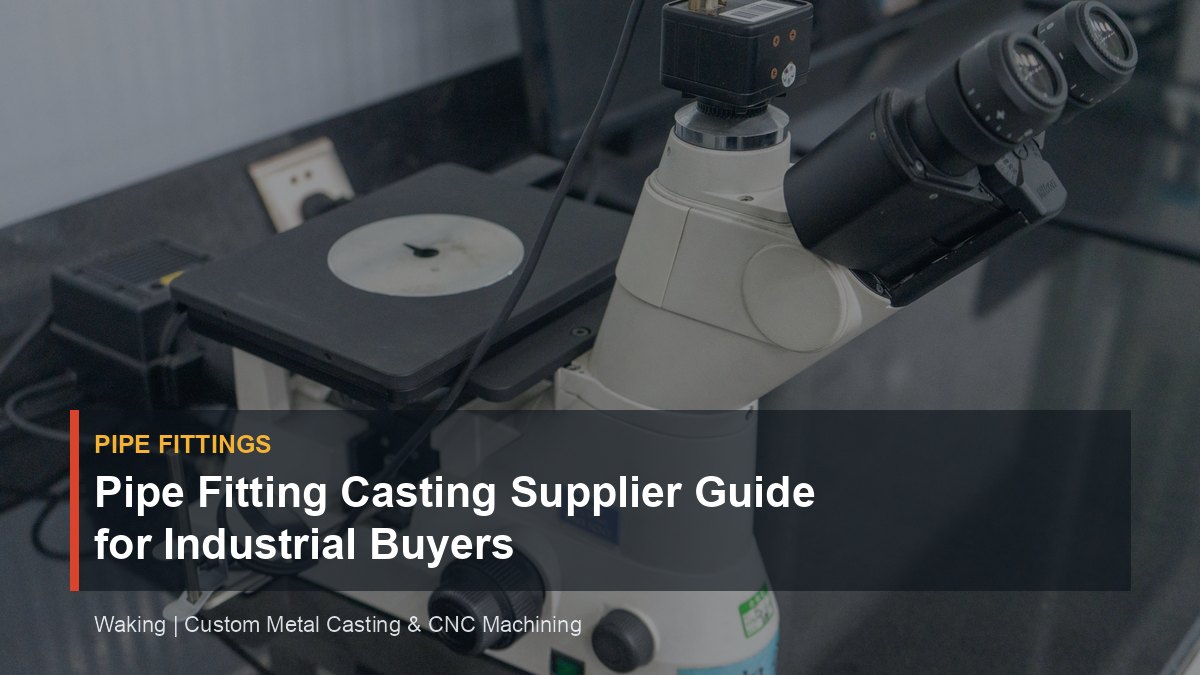
Material structure matters just as much as geometry. An inverted metallurgical microscope lets a foundry check the structure of the cast material, which matters when a fitting gets welded or sees thermal cycling. And if your application runs at low temperature, ask about impact testing. A pendulum impact tester covers that, including low-temperature impact performance. It is a specific piece of equipment, and fewer foundries own it than claim they do.
Ask for dimensional evidence you can actually read
A quality stamp that just says “passed” is not evidence. For critical features on a fitting, sealing diameters, wall thickness, thread position, flange bolt patterns, you want measured numbers, not a checkmark.
Waking’s quality lab runs two CMMs, a COORD3 and a ZEISS SPECTRUM, plus roundness and contour measuring equipment and hardness testers. A portable measuring arm covers larger parts that do not fit on a bench. That equipment generates numbers, and those numbers should reach you inside the inspection report.
Before production, use the sample approval process to lock down expectations. Agree on which dimensions are critical for your assembly, and require first article inspection results on those features. Then use batch traceability to tie those results to a specific heat of material and a specific inspection record. If a fitting fails in the field, this paper trail tells you whether you have one bad batch or a systemic problem.
Also confirm how parts are identified. Heat codes and part numbers need to survive the machining process, so agree on marking location and method during the sample approval stage. Marking is cheap. Losing traceability is expensive.
Check the commercial side before you commit
The cheapest quote is rarely the cheapest fitting. The real cost shows up in scrap, delays, and field failures. Here is what to verify on the commercial side.
First, confirm you are dealing with a factory. Waking has been in Qingdao since 2002, operates a 70,000 m² production base, and holds ISO 9001 and IATF 16949 certifications. The company is explicit on the point: a real casting factory, not a trading company. That distinction matters because a trading company cannot answer process questions about gating, risers, X-ray results, or machining tolerances. Ask who walks the foundry floor. Ask for photos of the inspection lab. A real factory has equipment to show.
Second, evaluate the engineering review. The Waking workflow is simple: send drawings and requirements, receive an engineering review and quote, then casting, machining, and delivery. The depth of that review tells you a lot. A supplier who comes back with questions about wall thickness, draft angles, tolerances, gate locations, and inspection requirements is thinking about your part. A supplier who quotes instantly without questions is pricing a guess.
Third, talk numbers honestly. Nobody can give you a meaningful lead time or MOQ without your specific drawing in hand. Confirm the exact lead time and MOQ with the supplier for your specific part. A realistic lead time that holds is worth more than an aggressive one that breaks. Ask how they handle schedule changes, because casting capacity fills in cycles and a good supplier will tell you when they are busy.
Last, send a complete package the first time. Here is what belongs in it:
- Drawing with the material grade, and whether it is a cast or wrought designation
- Service pressure, media, and temperature range
- Joining method: threaded, welded, flanged, or clamped
- Required inspections: X-ray, leak testing, impact testing, dimensional checks
- Annual volume and any expected growth
- Packaging and marking requirements
The more the foundry knows before quoting, the fewer surprises you get in production. That is the difference between buying a casting and buying a casting process. For pressure-containing pipe fittings, the process is what keeps the part from leaking.
Frequently Asked Questions
My drawing specifies AISI 304 for cast pipe fittings, but the supplier asks if we mean CF8. Which grade should I use for a cast part that will be welded?
For castings, CF8 and CF8M are the cast equivalents of 304 and 316, so specifying only a wrought grade like 304 without stating the manufacturing process can cause a mismatch. Waking works with 304/316 and CF8/CF8M, and during engineering review the foundry can confirm the correct cast grade and carbon level for weldability. Always raise this before production to avoid drawing misinterpretation.
Is X-ray inspection and leak testing standard for pipe fitting castings, or are they extra charges?
Not every foundry includes these as standard, so ask directly whether X-ray inspection is default or an extra, what percentage of parts receive leak testing, and which acceptance criteria apply. Waking screens castings with X-ray NDT on an XTH320 system and writes leak testing into the quality process for pressure-containing parts, but the scope should be confirmed with the supplier for your specific part.
If the casting is subcontracted to a different machine shop, who takes responsibility when a thread is out of position on the final machined fitting?
When casting and machining are split, you own the interface and the blame dispute. Waking keeps casting and CNC machining under one roof with 400+ in-house CNC machines, so the same team controls casting and machined dimensions and first article inspection is done on the finished part. Ask any supplier without an in-house machining line how they manage tolerance disputes and final dimension responsibility.
How do you ensure heat codes and material certificates stay linked to the correct parts after CNC machining and finishing?
The foundry should issue material certificates and inspection reports against the same batch and link them to the finished parts, not just raw castings. Waking uses batch traceability, and heat codes and part numbers must survive machining; marking location and method are agreed during sample approval. This paper trail lets you tie any field failure back to a specific heat of material.
Key Parameters at a Glance
| Quality Check Item | In-house Equipment / Process | Why It Matters for Pipe Fittings |
|---|---|---|
| Internal defect detection | X-ray NDT (XTH320) | Detects porosity and shrinkage that can cause leaks in pressure-containing parts |
| Dimensional verification | CMM (COORD3, ZEISS SPECTRUM), roundness/contour measuring, hardness testers | Provides measured values for sealing diameters, wall thickness, thread position, and flange bolt patterns |
| Material structure and low-temperature impact | Inverted metallurgical microscope, pendulum impact tester | Checks microstructure for welding/thermal cycling and verifies low-temperature impact performance |
| Pressure integrity | Leak testing written into quality process (confirm % and acceptance criteria) | Verifies no leaks on finished pipe fittings for pressure service |
| Traceability | Heat codes, batch traceability, material certificates issued together | Links finished parts to a specific heat of material for failure analysis |
