
Aluminum gravity casting gets less attention than die casting or low pressure casting, but it earns its place on many shop floors. It sits between sand casting and pressure-assisted processes in both cost and capability. For a purchasing manager with a new part to source, the question is not which process is best in the abstract. The question is which process fits this part. Here is how to tell.
What aluminum gravity casting is
Gravity casting means exactly what the name says. Molten aluminum is poured into a permanent metal mold, and gravity does the filling. There is no pressure pushing the metal in, and there is no centrifugal force spinning it.
The mold is not destroyed after each pour, as it is in sand casting. It is a reusable steel mold, which is why the process is sometimes called permanent mold casting. Because the metal mold pulls heat away quickly, the aluminum solidifies with a finer grain structure than sand casting typically produces. That means better mechanical properties and a cleaner surface finish.
Compare that with low pressure casting, where gas pressure pushes metal up into the mold from below. Low pressure fills cavities more consistently and with less turbulence, making it a strong choice for pressure-tight parts and more complex internal geometry. Gravity casting pours from the top or at an angle, so the gating and venting design has to do more work.
All three processes have their place. The mistake is choosing based on habit rather than on the part.
Parts that fit gravity casting well
Gravity casting tends to fit parts with these characteristics:
- Medium to higher volumes. Tooling costs more than sand casting tooling, but the per-part cost is lower and the mold lasts far longer.
- Dimensional consistency across batches. The same steel mold produces repeatable parts, run after run.
- Good surface finish requirements. Better than sand casting, though not as fine as die casting at very high volumes.
- Solid mechanical properties. The rapid cooling in a metal mold gives aluminum alloy a finer grain structure than sand casting, which benefits strength.
Common parts include automotive housings, industrial machinery housings, and pump and valve components. Waking runs gravity aluminum casting as an in-house line, and those application areas show up in orders coming through the factory all the time.
Gravity casting is a weaker fit when a part needs very thin walls, long intricate internal passages, or geometry that cannot be ejected from a rigid metal mold. For those, low pressure casting or investment casting may serve you better. Waking has all three lines in-house, so engineers can compare the options honestly instead of pushing you toward one process because it is the only one available.
Design details that make or break a gravity casting
Because the mold is a solid block of metal, the part must come out of it. That means draft is mandatory. Sand molds collapse and give way; steel molds do not. Without draft, the part will not eject cleanly and the tooling will take abuse.
- Keep wall thickness as uniform as possible. Thick and thin sections cool at different rates, which invites shrinkage porosity where they meet.
- Avoid sharp corners. Radius them. Sharp corners concentrate stress and disrupt metal flow.
- Watch for bosses and ribs. They act as local heat sinks. If they are too heavy relative to the surrounding wall, they will shrink on their own.
- Plan for cores and inserts carefully. Cores add complexity and cost. Sometimes a simple redesign removes the need for them.
This is why you should send drawings to the foundry before the tool is cut. Waking’s process starts with exactly that: send drawings and requirements, get an engineering review and quote, then casting, machining, and delivery. The engineering review is not a formality. It is where an experienced casting engineer catches the features that will cause problems in the mold and suggests changes while the part is still cheap to modify.
Porosity is the main quality risk — ask how it is checked
Gravity casting is not a forgiving process. Pour temperature, mold temperature, gating, venting, and mold coating all affect the result. If the metal fills turbulently, gas gets trapped. If solidification is uneven, shrinkage opens up. The result is porosity — the defect that reveals itself later, after machining, during pressure testing, or in the field.
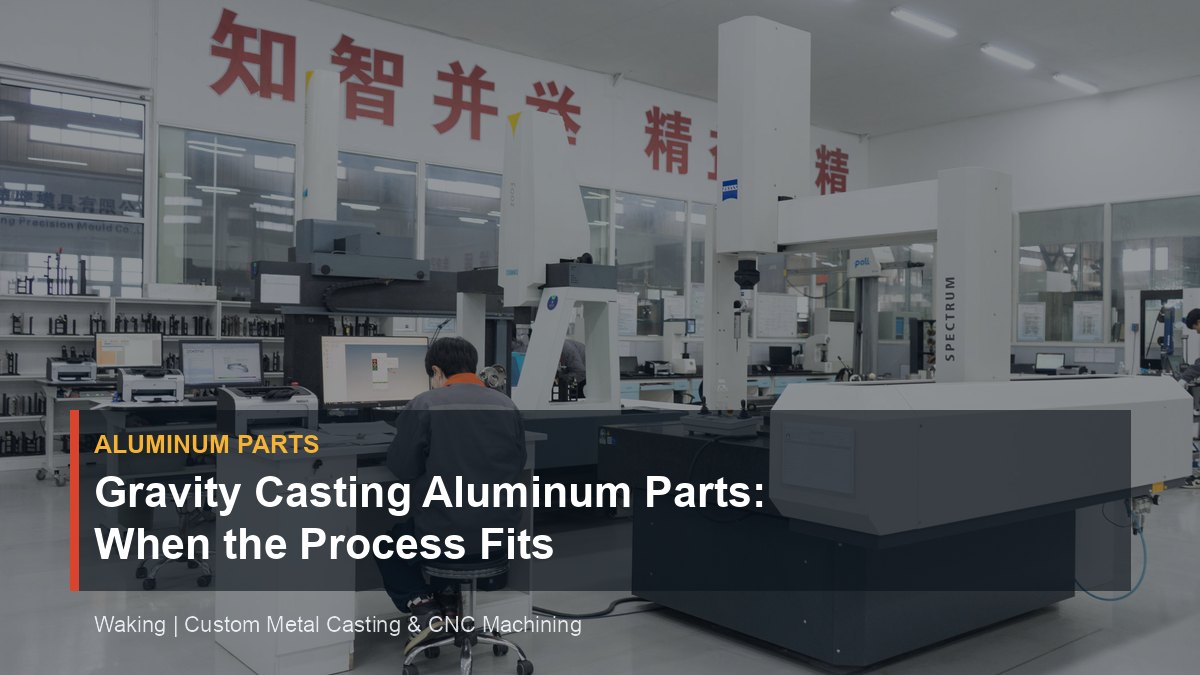
So the inspection side matters as much as the pouring side. Ask the supplier what they actually do to find internal defects. Not every foundry has real X-ray capability in-house. Waking does. The quality lab includes an XTH320 X-ray NDT system for detecting gas pores and shrinkage inside castings, plus CMM measuring machines from COORD3 and ZEISS SPECTRUM for dimensional verification, and an inverted metallurgical microscope for material structure analysis.
For parts that must hold pressure, do not stop at X-ray samples. Ask about leak testing. Waking performs leak testing for pressure-containing parts, and the inspection reports follow the batch. That is part of traceability: material certificates, inspection reports, and batch records all come together.
You also want first article inspection and a sample approval step before mass production. If the supplier cannot show you a documented sample approval process, treat that as a warning sign.
What to check before you commit to a gravity casting supplier
Cutting through the marketing, here is the short list:
- Is it actually a foundry? Waking says it plainly: “A Real Casting Factory, Not a Trading Company.” Buyers get burned by trading companies that mark up drawings and forward them. A real factory answers technical questions with production knowledge, not sales scripts.
- Where does machining happen? If the foundry ships castings to a third party for CNC work, quality control gets more complicated. Waking has 400+ CNC machines in the same factory, so castings move from the foundry line to machining without leaving the site.
- What certifications exist? ISO 9001 and IATF 16949 are worth asking for. Waking holds both.
- What finishing is available? Heat treatment, anodizing, polishing, plating, passivation, coating. Ask whether it is handled in-house or subcontracted. Waking offers these finishing steps as part of the same production flow.
- How does quoting work? It should start with drawings and requirements, then an engineering review, then a quote. If a supplier quotes before engineering looks at the part, be suspicious.
Lead time and minimum order quantity vary by part. The honest answer is to confirm them with the supplier for your specific drawings. A supplier who gives you a number before seeing the part is guessing.
Gravity casting is not the answer to every aluminum part. But for parts in the middle range — metal molds, repeatable runs, mechanical strength, good finish — it is often the smartest fit. The trick is to work with a supplier that has enough process range to discuss the comparison fairly, and enough inspection capability to prove the parts are good.
Frequently Asked Questions
How does gravity casting compare with low pressure casting for aluminum parts that must hold pressure?
Gravity casting fills the permanent mold by pouring from the top or at an angle, so gating and venting design must control turbulence. Low pressure casting pushes metal up from below with gas pressure, filling cavities more consistently and with less turbulence, which is usually a stronger choice for pressure-tight parts and complex internal geometry. For gravity cast parts that must hold pressure, ask the supplier about leak testing, not just X-ray sampling.
What part geometry makes gravity casting a poor fit?
Parts with very thin walls, long intricate internal passages, or shapes that cannot be ejected from a rigid steel mold are weaker fits. The mold is a solid block of metal, so draft is mandatory and the part must come out of it. Cores and inserts add complexity, so sometimes a simple redesign removes the need for them.
How do you check for internal porosity in gravity cast aluminum parts?
Porosity is the main quality risk because turbulent filling can trap gas and uneven solidification can open shrinkage. Ask what the foundry actually does to find internal defects. Waking has an XTH320 X-ray NDT system to detect gas pores and shrinkage inside castings, CMM machines for dimensional verification, and performs leak testing for pressure-containing parts, with inspection reports following the batch.
Why is the engineering review step important before gravity casting tooling is cut?
It is where an experienced casting engineer catches features that will cause problems in the mold, such as draft, wall thickness, sharp corners, bosses, ribs, and cores, while the part is still cheap to modify. Waking's process starts with submitting drawings and requirements, then engineering review and quote, then casting, machining, and delivery.
Key Parameters at a Glance
| Item | Details |
|---|---|
| Process | Permanent mold gravity casting: molten aluminum poured into reusable steel mold; no pressure or centrifugal force |
| Alloy | Aluminum alloy |
| Tooling | Reusable steel mold; tooling cost higher than sand casting, but lower per-part cost at medium to higher volumes |
| Dimensional consistency | Same steel mold produces repeatable parts run after run |
| Surface finish | Better than sand casting; not as fine as die casting at very high volumes |
| Mechanical properties | Finer grain structure than sand casting due to rapid cooling in metal mold |
| Design rules | Mandatory draft; uniform wall thickness; radius sharp corners; watch heavy bosses/ribs; plan cores carefully |
| Better fit | Medium to higher volumes; automotive housings, industrial machinery housings, pump and valve components |
| Weaker fit | Very thin walls, long intricate internal passages, geometry that cannot be ejected from rigid metal mold |
| Quality inspection | XTH320 X-ray NDT, CMM (COORD3 and ZEISS SPECTRUM), inverted metallurgical microscope, leak testing for pressure-containing parts, FAI/sample approval, batch traceability |
