Phone:
+86 15005422253
Physical address:
Pingdu City, Qingdao,
Shandong Province, China.

Phone:
+86 15005422253
Physical address:
Pingdu City, Qingdao,
Shandong Province, China.
Plan valve body investment casting by reviewing stainless material, wall thickness, ports, sealing faces, machining, leak testing and certificates.
Valve bodies hold pressure, direct flow, and face corrosive service. That combination makes the investment casting valve a natural fit: one-piece construction, complex internal passages, and cast stainless grades that handle both pressure and corrosion. For a purchasing manager, three things decide whether a supplier is worth the risk: material control, in-house machining, and real leak verification.
Waking has been casting in Qingdao since 2002. The site is 70,000 m² and runs casting, CNC machining, and inspection under one roof. That sounds like brochure language, but for a pressure-containing part it is simply the difference between controlling quality and hoping for it. We are a factory, not a trading company — and for a valve body, that distinction is not sentimental. It is practical.
Most valve-body drawings that cross our desk specify stainless steel. Often the buyer writes “304” or “316” without thinking about the difference between a wrought bar and a casting. A valve body is cast, so the correct reference points are the cast grades: CF8 and CF8M.
CF8 is the cast equivalent of 304. CF8M is the cast equivalent of 316. If your drawing only says 304, ask the foundry to confirm that the cast grade and heat treatment match the intended service. CF8 suits general duty — water, steam, mild chemicals. CF8M adds molybdenum, which improves resistance to chlorides and pitting. If your media is seawater or aggressive process fluid, CF8M is usually the safer starting point. Write both numbers on the drawing — for example “316 / CF8M” — so there is no argument later about what the inspector should be checking.
Carbon steel and alloy steel bodies are still common for high-pressure or high-temperature services where stainless is overkill or where cost matters. The foundry should be able to tell you which heat treatment applies to that material. Waking treats heat treatment in-house, which keeps the process sequence clean. And when a valve is a light, low-pressure component, aluminum bodies make sense — but those are often better matched to low-pressure or gravity casting than to investment casting. Waking has those lines too, so the material and process can be chosen together rather than forced into one route.
Investment casting gives you near-net shape, but a valve body is not finished until the machining is done. Sealing faces, flange faces, bores, threads, and seat areas all come from CNC work. The geometry of those features decides whether the body seals in service.
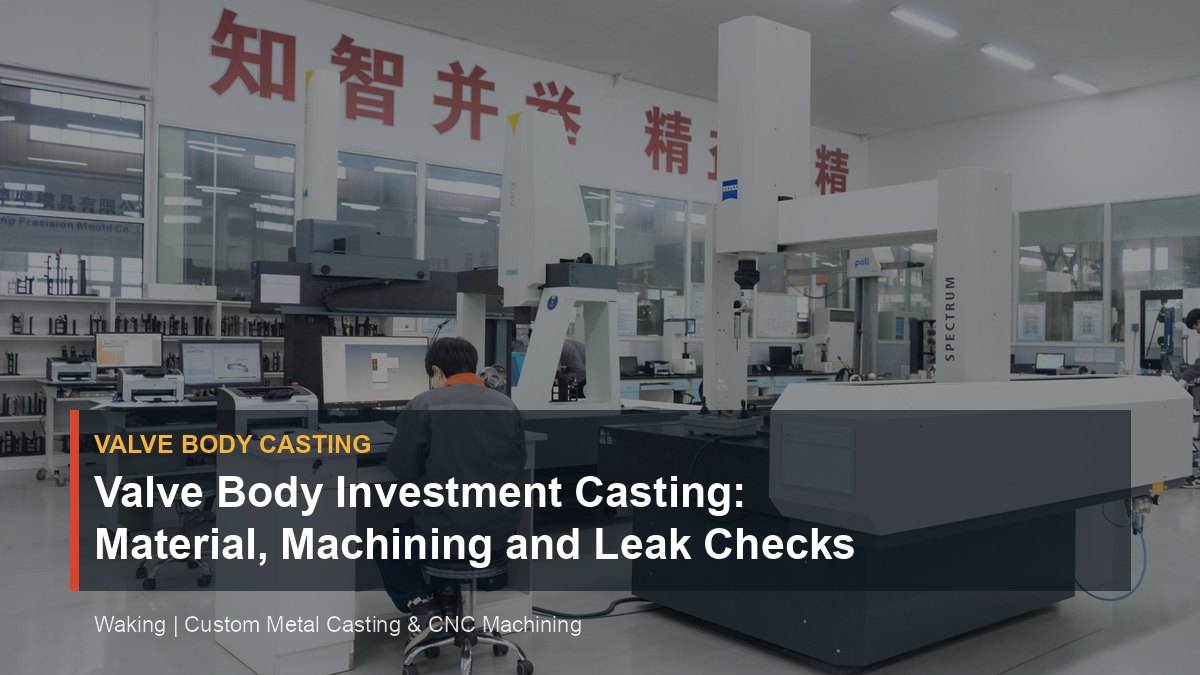
This is why a supplier who only casts — and then sends the part to a third-party machine shop — puts you in a weak position. Casting and machining become two contracts, two inspection regimes, and two sources of finger-pointing when a bore is out of round. Waking keeps machining in-house: more than 400 CNC machines sit inside the same plant as the casting lines. The casting does not travel between vendors. First article inspection is part of that flow, and the CMMs — a COORD3 and a ZEISS SPECTRUM — are used to check real geometry, not paper promises.
What should you ask for on a machined valve body? Dimensional results on the sealing faces and the bore alignment. Flatness and perpendicularity matter as much as the nominal sizes. And remember that a valve body often needs more than machining: deburring, polishing, passivation, or other finishing steps. If those happen in the same factory, the part stays traceable from raw casting to export crate.
The most dangerous valve-body defect is the one you cannot see. Porosity and shrinkage hiding inside the pressure wall can pass a visual check and still leak after installation. X-ray non-destructive testing is the right screen for that. Waking uses an XTH320 X-ray system to look inside the casting for gas holes and shrinkage. If your supplier only offers a surface inspection and a certificate, that is a red flag for pressure parts.
But internal-soundness testing does not prove a body is leak-tight. For pressure-containing parts, leak testing comes after machining — when the sealing faces and threads actually exist. Check the wording: Waking’s capability includes leak testing for pressure-containing parts, and that step is part of the production flow, not an afterthought.
Buyers should define the leak-test requirement on the drawing or in the purchase order. The method — pressure decay, submersion bubble testing, helium sniffing, or another technique — should be chosen for the part’s service and the acceptable leak rate. If you search for “pressure decay testing,” you will mostly find instrument manufacturers. What you actually need is a casting supplier that treats leak verification as a standard production step. So specify these parameters on the drawing and in the PO:
Every leak threshold is a blank space on your drawing unless you fill it in.
Finally, do not forget the material side of sealing. If the body will see low temperatures, ask about impact testing. Waking’s testing includes a pendulum impact tester with low-temperature capability. A brittle valve body is a cracked valve body, and an X-ray from last week will not tell you about today’s lot. The batch traceability, material certificate, and inspection reports should come out of the same drawer — and every raw casting should carry a batch or heat marking that follows it through machining.
Qualifying a casting supplier for valve bodies should feel like an engineering exercise, not a commodity purchase. At Waking the flow is simple: you send drawings and requirements, we do the engineering review and quote, then casting, machining, and delivery run in one sequence. That three-step process keeps the commercial and technical sides aligned.
Ask for the sample approval process before production begins. That includes your review of the first article, the material certificate, dimensional data, and leak-test results. And do not let a supplier talk you out of it. A valve body is the kind of part that either seals for a decade or fails at the worst possible moment; the upfront approval is cheap insurance.
One more point about commercial expectations: lead times and MOQs are part-dependent. A heavy alloy-steel body and a small aluminum body are different animals. A serious casting supplier will give you a realistic lead time and a sensible MOQ after seeing your drawing — not a universal number pulled from a brochure. Confirm those details for your specific part and keep the door open to batches that match your actual usage. That is how you buy a valve body casting: material first, machining second, leaks checked with real evidence, and the supplier held to a defined approval step.