
If you are sourcing a gravity casting project, the tooling quote is usually the first number that makes you pause. Gravity casting uses a permanent metal die, machined from steel. That die is the process: it shapes every casting, controls cooling, and sets the tolerances you can hold. Waking, a casting factory in Qingdao, China founded in 2002, runs gravity aluminum casting in-house, and our quoting process starts with an engineering review of the drawing, not with a price list.
What the die actually contains
A gravity die is not a simple two-piece mold. Even a plain-looking housing needs:
- Die blocks that carry the negative shape of the part
- A gating system to fill the cavity evenly, plus risers to feed shrinkage as the metal cools
- Cooling channels drilled into the steel to control solidification
- Ejector pins to push the casting out of the die
- Slides or cores if the part has undercuts or internal features
Every one of these is designed, machined, assembled, and tested. So the tooling price is not really a price for steel. It is a price for engineering, and for the precision machining that turns steel into a repeatable process.
Part geometry sets the baseline
Before any steel is ordered, the die designer works from the part drawing. Three geometry decisions move the quote more than anything else.
Parting line. A flat, simple parting line is the cheapest. A parting line that steps, angles, or curves across the part means the die blocks must be machined to match each other in three dimensions. That is extra machining time and a tighter fit-up tolerance.
Undercuts. Any feature that locks into the die needs a movable slide or a core. Each slide adds matched machining, moving parts, and wear over time. A single undercut can add more to the tooling quote than the rest of the cavity.
Draft. Gravity casting needs draft so the casting releases from the die. Too little draft forces either a more complex ejection design or machining on the part later. Someone has to decide where the draft goes, and which side of the nominal dimension it lands on. That decision belongs in the engineering review, not after tooling is cut.
Deep ribs, thin walls next to thick bosses, and large flat areas all affect cooling and filling. The die designer must add cooling control or adjust the feeding design. None of this is visible on the final part, but all of it shows up in the tooling quote.
Die material, cavity count, and cooling design
Expected production volume drives the die material decision. A short-run program can be handled with a simpler die and a more basic steel specification. A high-volume program needs die steel that can take repeated thermal cycling without cracking or losing its shape, plus proper heat treatment of the die itself. Do not specify a die material by habit. Size it to the actual production plan.
Cavity count follows the same logic. A single cavity is the lowest tooling cost and the slowest per-part output. Two or four cavities cost more upfront but lower the piece price. The right answer depends on annual volume and the casting machines you are quoting against. A supplier should explain the trade-off in its quote, not just pick a number.
Cooling design is where good dies earn their money. Coolant channels must be placed so solidification moves in one direction and shrinkage is fed by the risers. Badly placed cooling means slow cycles and porosity in thick sections. But drilled cooling channels are extra machining in the die block, and they add to the quote. This is one area where cheap tooling shows up later as scrap rate.
Tolerances, finish, and the machining trade-off
Here is the most common mistake we see in casting drawings, and it applies to gravity casting as much as to any process: tolerances are called out on surfaces that the die cannot possibly hold, or that do not need to be held at all. Every tight tolerance on a cast surface pushes complexity into the die and raises its cost without helping the part function.
The better route is to cast a surface to a normal casting tolerance and machine the critical dimensions afterward. At Waking, CNC machining is done in-house on more than 400 machines, so our engineering review can look at a feature and tell you, honestly: this should be cast, or this should be machined. When both steps live in the same factory, that decision is easier and the quote is more realistic.
Surface finish also starts in the die. A polished cavity can produce a smooth casting surface, but polishing a die cavity costs money and is harder to maintain over time. If the part will be anodized or coated, the finish requirement should be stated in the drawing and accounted for in the die specification.
What a real tooling quote includes beyond the die
A tooling quote is not complete if it only covers cutting steel. The work that matters is proving the die.
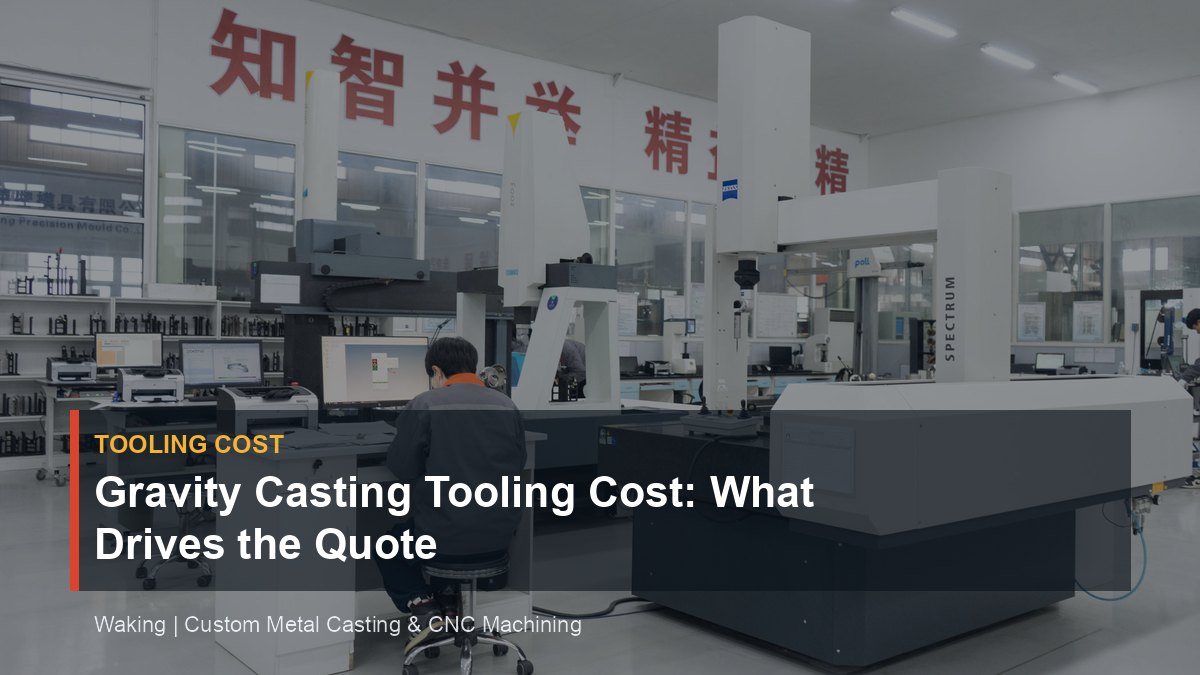
After the die is built, it goes through trial runs. Sample castings are measured, sectioned when needed, and checked for internal defects. This is where the quality of the die design becomes visible. At Waking, the inspection equipment is in-house: two CMMs (COORD3 and ZEISS SPECTRUM) for dimensional verification, an XTH320 X-ray system for internal soundness, an inverted metallurgical microscope for material structure, and leak testing for pressure-containing parts. First Article Inspection and sample approval are a standard part of the process.
If a tooling quote never mentions trial shots, sampling, or the dimensional evidence you will receive, ask why. You are not buying a block of steel. You are buying proof that the die produces acceptable parts, repeatably.
Questions to ask before you approve a tooling quote
- What exactly is included: die design, machining, heat treatment, assembly, and how many trial shots?
- What die material is specified, and what production life is it sized for?
- How many cavities are quoted, and what does that mean for the piece price at your annual volume?
- What inspection evidence comes with sample approval: a dimensional report, X-ray results, leak test results?
- What is the change policy if the part design is modified after sampling?
The right tooling quote is not the cheapest one. It is the one that matches the die to your geometry, your volume, and your quality requirements. Send the drawing first, let the engineering review do its work, and then compare quotes on the same scope.
Frequently Asked Questions
Which part geometry features have the biggest impact on gravity casting tooling cost?
Parting line, undercuts, and draft drive the quote more than anything else. A stepped or curved parting line adds 3D matching machining and tighter fit-up, undercuts require movable slides or cores, and insufficient draft forces complex ejection or later machining. Deep ribs, thin walls next to thick bosses, and large flat areas also affect cooling and feeding design.
How does cavity count affect the tooling quote and piece price?
A single cavity has the lowest tooling cost but the slowest per-part output. Two or four cavities cost more upfront but lower the piece price. The right choice depends on annual volume and the casting machines quoted against, and the supplier should explain the trade-off.
What should a complete gravity casting tooling quote include beyond the die itself?
It should include die design, machining, heat treatment, assembly, trial shots, sample casting dimensional and internal defect inspection, first article inspection, and sample approval. At Waking, CMMs, X-ray, metallurgical microscope, and leak testing are in-house, and if a quote omits trial shots or dimensional evidence, ask why.
How do tolerances and surface finish requirements affect tooling cost?
Tight tolerances on cast surfaces push complexity into the die and raise cost without necessarily helping part function, so it is often better to cast to normal tolerance and machine critical dimensions afterward. A polished cavity produces a smooth casting finish but costs more and is harder to maintain; finish requirements should be stated in the drawing and accounted for in the die specification.
Key Parameters at a Glance
| Cost driver | Impact on tooling quote | What to verify / ask |
|---|---|---|
| Parting line | Stepped, angled, or curved parting lines add 3D machining time and tighter fit-up tolerance; flat simple parting lines are cheapest | Ask whether the parting line can be simplified without affecting part function |
| Undercuts | Each undercut requires a movable slide or core, adding matched machining, moving parts, and wear | Confirm number of slides/cores and their cost in the quote |
| Draft | Too little draft forces complex ejection design or later machining; draft placement affects nominal dimensions | Review where draft is applied and which side of dimension it lands on |
| Die material | Short-run programs can use simpler steel; high-volume needs heat-treated steel that withstands thermal cycling | Ask what die material is specified and what production life it is sized for |
| Cavity count | Single cavity lowest tooling cost, multi-cavity higher upfront but lower piece price | Ask how quoted cavity count affects piece price at your annual volume |
| Cooling channels | Drilled cooling channels add machining but control solidification and reduce porosity in thick sections | Ask how cooling design is placed to feed shrinkage and avoid scrap rate |
| Cast surface tolerances | Every tight tolerance on a cast surface increases die complexity and cost; machining critical surfaces afterward is usually better | Ask which features can be cast to normal tolerance and machined later |
| Surface finish | Polished cavity gives smooth casting but costs more and is harder to maintain; finish requirements must be specified if part is anodized or coated | State finish requirement in drawing and check it is accounted for in die specification |
