
Choosing a casting manufacturer for pump and valve parts is different from sourcing decorative castings. Your parts hold pressure. They see corrosive media. A hidden shrinkage void can leak, crack, or fail in service. So you need a supplier who treats casting as an engineering discipline, not just a metal-shaping service.
Waking has run a real casting factory in Qingdao, China, since 2002. The facility covers 70,000 m² and exports to more than 40 regions. This guide covers the casting processes, materials, and inspection steps that matter when you buy pump and valve castings, plus the questions to ask before you commit.
What makes pump and valve castings different
Valve bodies, impellers, and pump housings are not cosmetic parts. They contain fluid under pressure. They have to seal against mating components. Many work in corrosive or high-temperature service.
That changes how you evaluate a foundry. Surface finish matters, but internal soundness matters more. A part can look perfect on the outside and still have shrinkage porosity in a thick wall. With pressure parts, you cannot judge quality by eye.
Material choice and process control are what protect you. Water, chemicals, steam, seawater — the media list in a pump and valve plant is long. Stainless steel casting is the default for many of these parts, with grades like 304 and 316 covering a wide range of service conditions. For cast versions, CF8 and CF8M are the stainless casting grades written into many valve specifications.
Casting processes that fit pressure parts
For pump and valve components, the process choice comes down to geometry, material, and volume.
Investment casting — also called lost wax casting — is a strong fit for stainless steel valve bodies and impellers. Waking runs silica sol investment casting in-house for stainless steel, carbon steel, and alloy steel. The process gives good surface finish and tight dimensional consistency, which means less machining and fewer surprises later.
For aluminum components such as pump housings and covers, low pressure casting and gravity casting are both solid options. Low pressure casting feeds the mold from below under controlled pressure, which helps fill thin sections and reduce porosity. Gravity casting is simpler and often more economical for certain geometries. Ask the supplier to recommend one based on your drawing, not on what they find convenient.
Machining is next, and it exposes what the foundry really produced. Many casting defects only become visible after machining opens up the surface. If casting and machining happen in the same plant, problems get caught early and fixed internally. Waking has more than 400 CNC machines of its own. Nothing ships out to a third-party machine shop. From the buyer’s side, that means one accountable party for the whole chain.
This is also where trading companies show their weakness. A trader can coordinate castings and machining across several factories, but coordination is not control. When you work with a real casting factory, the people who made the part answer for it. Waking says it plainly: “A Real Casting Factory, Not a Trading Company.” For pressure parts, that distinction matters.
Materials, finishing, and traceability
Material selection for pump and valve parts usually starts with stainless steel because the service media are aggressive. The 304 and 316 grades are workhorses. CF8 and CF8M are the stainless casting grades you’ll see specified for valves. Carbon steel and alloy steel work where the service allows and the cost case is clear. Aluminum alloy covers lighter housings and covers with lower pressure and corrosion demands.
Do not let the supplier choose the material alone. Send your drawing with the grade specified. If you are unsure, give them the media, the pressure, and the temperature range. A good engineering team will recommend a grade and explain why.
Finishing steps also affect how the part performs. Heat treatment adjusts material structure and mechanical properties. Passivation helps stainless steel resist corrosion. Polishing, deburring, and cleaning remove surface imperfections. Coatings, plating, and anodizing protect aluminum and steel parts for specific services. Ask which steps are included in the quote and which are extra. Get it on paper.
Traceability is not optional for pressure parts. Every casting should be traceable back to its batch, and the material certificate should match the inspection report. Permanent marking on the raw casting — before machining — keeps that chain intact. If a part fails years later, you need to know which batch it came from. Waking keeps batch traceability and issues material certificates with inspection reports, so the buyer gets one consistent record.
Inspection and testing — where the real risk sits
Casting quality control for pressure parts comes down to one question: can the supplier prove the part is sound? Casting porosity and shrinkage are the defects that worry pump and valve buyers. Both are internal. Both can cause leaks. Neither shows up on a visual check.
Ask what inspection equipment the supplier owns, not what they can borrow. These are the pieces that matter:
- X-ray NDT. Waking uses an XTH320 X-ray system to screen internal defects like porosity and shrinkage. If a supplier has no internal X-ray capability, ask how they verify soundness at all.
- CMM measurement. Waking runs COORD3 and ZEISS SPECTRUM coordinate measuring machines to verify critical dimensions and sealing surfaces.
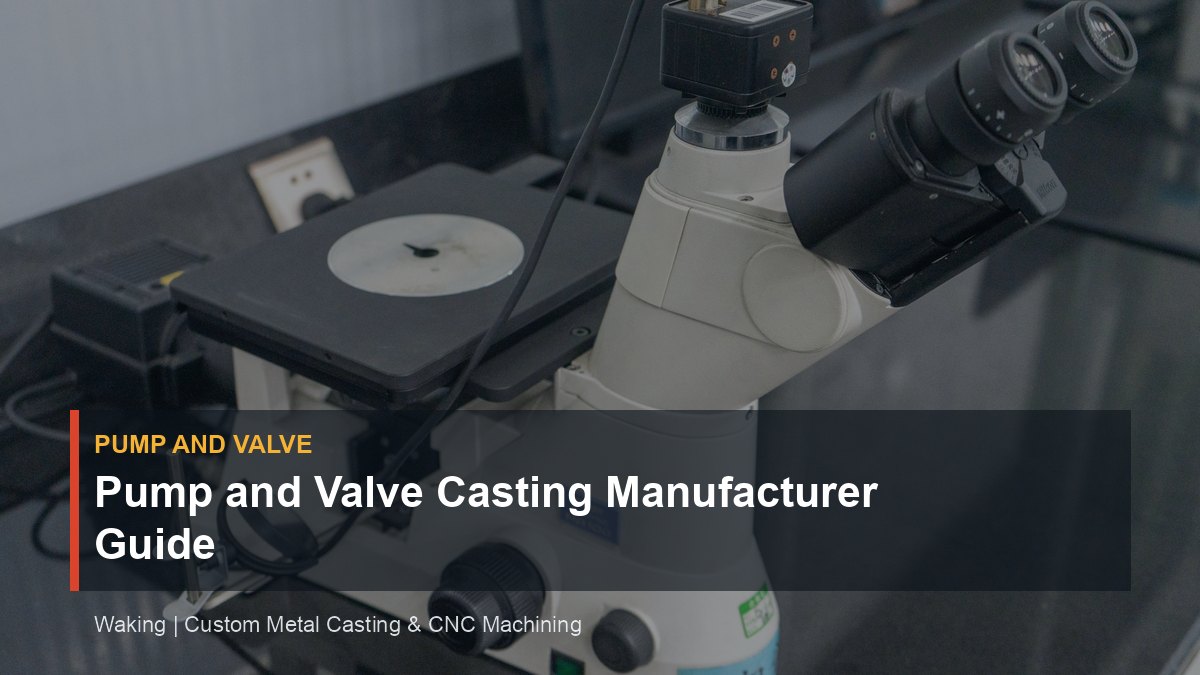
- Metallurgical microscope. An inverted metallurgical microscope checks material structure and confirms heat treatment results.
- Impact testing. A pendulum impact tester, with low-temperature capability, matters for valves in cold service.
- Roundness, profile, and hardness. These catch problems in sealing faces and material consistency.
Leak testing deserves its own paragraph. For pressure-containing parts, it is the test that proves the part will hold fluid. Buyers often refer to the common method as pressure decay testing: pressurize the part, then watch for a pressure drop over time. The method name matters less than the criteria. What test pressure? What hold time? What leak rate is acceptable? Write the answers into your specification before production.
Ask for process discipline too. First article inspection before a new part goes into production. Sample approval before you release the order. Dimensional reports with real measured values, not checkmarks. Waking follows a three-step flow: you send drawings and requirements, engineers review and quote, then casting, machining, and delivery happen in-house. Review before production, not after.
How to evaluate a pump and valve casting supplier
If you buy valve body castings or impellers regularly, your evaluation should be tougher than for generic parts. Work through these questions:
- Factory or trader? Ask for the address, plant size, and equipment list. Waking operates a 70,000 m² base in Qingdao with its own casting lines and its own machining shop. Vague answers about where casting happens are a red flag.
- Certifications. ISO 9001 covers basic quality management. IATF 16949 goes further with stronger process control and traceability requirements. Waking holds both.
- In-house machining. A casting manufacturer with its own CNC capacity — Waking has 400+ machines — keeps dimensional quality under one roof.
- Speed and depth of quoting. A quick, technically detailed response to your drawing is a good sign. A slow or vague response is not.
- Lead time and MOQ. There is no honest universal number. Parts differ. Confirm the exact lead time and minimum order quantity for your specific part in writing.
- Visible inspection evidence. Photos of real equipment — CMM, X-ray, impact tester — beat generic quality claims. Waking’s quality page shows the actual inspection line.
What to send when you ask for a quote
A useful quote starts with a useful drawing. Include the material grade, pressure rating, media, temperature range, and testing requirements. If the part will be leak tested, say so. If surface finish matters, specify it.
Then let the supplier’s engineers ask questions. A serious casting manufacturer will come back with several. That is a good sign. It means they are reviewing your part, not just quoting a number.
Pump and valve castings are engineered parts that hold pressure and resist corrosion for years. Choose a casting manufacturer that owns its process, proves quality with real equipment, and answers for the part from melt to delivery. That is the short version of the whole guide.
Frequently Asked Questions
What casting process do you recommend for stainless steel pump and valve components?
For stainless steel valve bodies and impellers, investment casting (lost wax casting) is usually the strongest fit. Waking runs silica sol investment casting in-house, which provides good surface finish and tight dimensional consistency for pressure-containing parts.
Why is X-ray inspection important for pump and valve castings?
Shrinkage porosity and other internal defects are not visible on the surface, but they can cause leaks or failure under pressure. Waking uses an XTH320 X-ray system to screen internal defects, so buyers get evidence of internal soundness before machining or shipment.
Which stainless steel grades are available for cast pump and valve parts?
Common grades include 304 and 316 stainless steel, and the cast equivalents CF8 and CF8M for valve specifications. You should specify the grade on your drawing, or provide the service media, pressure, and temperature range so the engineering team can recommend a suitable grade.
Can Waking handle both casting and CNC machining in one factory?
Yes. Waking has more than 400 CNC machines in-house and keeps casting and machining under one roof. This helps catch casting defects when machining opens the surface and gives you one accountable party for the whole chain.
Key Parameters at a Glance
| Item | Waking Capability |
|---|---|
| Company / location | Waking, Qingdao, China; founded 2002 |
| Facility size | 70,000 m² production base |
| Export coverage | More than 40 regions |
| In-house CNC machines | 400+ |
| Quality system certifications | ISO 9001 & IATF 16949 |
| Casting processes | Silica sol investment casting; low pressure aluminum casting; gravity aluminum casting |
| Materials | Stainless steel 304/316/CF8/CF8M; carbon steel; alloy steel; aluminum alloy |
| Post-casting / finishing | Heat treatment, deburring, cleaning, polishing, passivation, coating, plating, anodizing |
| Inspection equipment | CMM (COORD3 & ZEISS SPECTRUM), X-ray NDT (XTH320), inverted metallurgical microscope, roundness/profile measurement, hardness tester, pendulum impact tester, leak testing for pressure parts |
| Traceability | Batch traceability with material certificate matching inspection report; permanent marking before machining |
| Typical applications | Pump and valve components (valve bodies, impellers), automotive and machinery housings, industrial machinery parts |
| Working process | ① Submit drawings and requirements ② Engineering review and quote ③ Casting, machining, and delivery |
