
Buying cast aluminum components is different from buying machined bar stock. If your part needs good strength, repeatable dimensions, and reasonable surface finish at medium volumes, aluminum gravity casting is one of the first processes to evaluate. This guide covers what the process is, what separates a real manufacturer from a middleman, and which quality checks actually matter for cast aluminum parts.
What Aluminum Gravity Casting Actually Is
Gravity casting uses a permanent metal mold. Molten aluminum alloy is poured in and fills the cavity under gravity alone. No pressure, no centrifugal force. Because the metal mold pulls heat out faster than a sand mold, the casting solidifies with a denser grain structure. That means better mechanical properties and fewer internal shrinkage problems than sand casting at comparable cost.
Where does it fit? For simple shapes and low volumes, sand casting is cheaper because tooling costs less. As volume climbs and dimensional consistency matters more, permanent tooling pays for itself through faster cycles and more repeatable parts. Gravity casting sits between sand casting and low pressure casting: moderate tooling cost, consistent quality, and a predictable production process.
It suits automotive housings, industrial machinery parts, and aluminum components with reasonably uniform walls. If a shape is extremely complex or thin-walled, low pressure casting often fills it better. If the part is steel or stainless, investment casting is usually the route. For medium-volume aluminum parts, gravity casting is frequently the answer.
Start With the Factory Question
The first question to ask any casting supplier is simple: do you own the production lines? A large share of companies that call themselves casting suppliers are traders. They take your order, send the drawing to a factory they don’t control, and add a margin. When something goes wrong, you deal with a middleman who can’t fix the process.
Waking is a real casting factory. That is not marketing talk; it is the central fact about the company. Founded in 2002 in Qingdao, China, Waking operates a 70,000 square meter production base with casting and machining under one roof. The company exports to more than 40 regions and holds ISO 9001 and IATF 16949 certifications. IATF 16949 matters if you source automotive parts; it signals a quality system audited to automotive industry standards.
Why does in-house production matter to you as a buyer? Three reasons. Accountability: one team owns both casting and machining, so there is no finger-pointing between a foundry and a machine shop. Speed: rework doesn’t require shipping parts between two companies. Economics: casting is designed with full knowledge of how the part will be machined.
Quality Control Questions That Separate Serious Suppliers
The main risk in gravity cast aluminum is internal porosity. Shrinkage and gas voids hide inside the part, invisible on the surface, and show up only as a leak or a machining problem later. How a manufacturer controls porosity tells you more than any brochure.
How do you inspect internal defects? X-ray NDT is the standard answer. Waking runs an XTH320 X-ray system in-house and screens castings for gas holes and shrinkage before machining. Suppliers who subcontract X-ray add cost, delay, and a feedback loop that disappears when the equipment is on site.
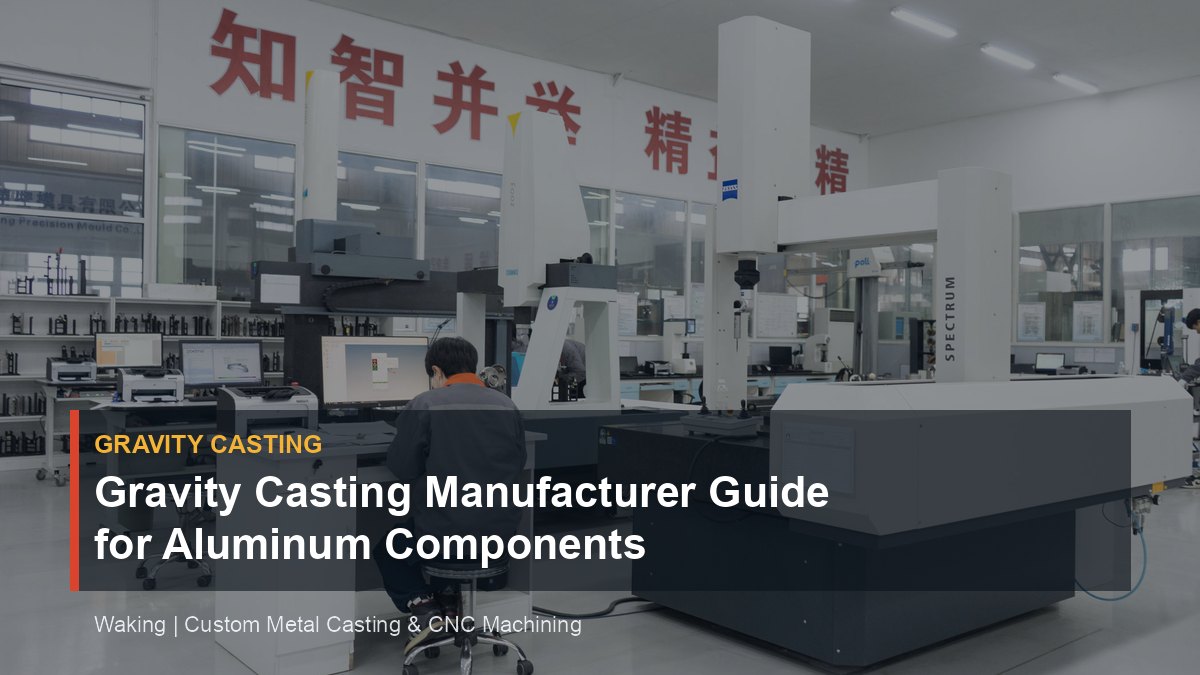
How do you control dimensions? Metal molds wear, and processes drift. CMM inspection catches drift before it becomes scrap. Waking operates two CMM systems — a COORD3 and a ZEISS SPECTRUM — plus roundness and contour measuring instruments and hardness testers. First article inspection is completed before mass production, and samples are approved before the order runs.
How do you verify the material itself? An inverted metallurgical microscope is used to examine the internal structure of the alloy. A pendulum impact tester, including low temperature impact testing, checks performance under real service conditions. If your part operates in cold environments, ask for the low temperature impact data.
Does the part have to hold pressure? Then leak testing is not optional. Waking performs leak testing on pressure-containing castings. Ask whether the supplier tests every piece or only samples, and what the acceptance criteria are.
What does traceability look like? Batch traceability, material certificates, and inspection reports should ship together. Six months from now, if a casting fails on your assembly line, you need to trace it back to its heat, its inspection record, and its production date.
The Machining and Finishing Handoff
You should not have to coordinate a separate machine shop after the casting is made. In a well-run supply chain, the foundry delivers a finished part, not a rough casting. Waking runs more than 400 CNC machines in the same plant, so machining happens immediately after casting, in-house, with no third-party handoff. Because casting and machining share one roof, datum features, machining allowances, and clamping points are planned with full knowledge of the casting process — coordination that is much harder when two separate companies are involved.
Alloy selection belongs to your engineering team. The supplier’s job is to run that alloy consistently, batch after batch. Waking’s aluminum lines cover both gravity and low pressure casting; the specific aluminum alloy is confirmed during the engineering review.
Surface treatment should be specified on the drawing, not decided after sampling. Cast aluminum can be deburred, cleaned, polished, anodized, plated, passivated, or coated. Heat treatment is available as well. Each step changes cost and lead time, so say upfront whether the surface is cosmetic or purely functional.
How the RFQ Process Should Work
Waking uses a straightforward three-step flow:
- Send drawings and requirements.
- Engineering review and quotation.
- Casting, machining, and delivery.
The difference between a good foundry and a mediocre one shows up in step two. A serious supplier comes back with questions about draft angles, wall thickness, parting line placement, and porosity risk before quoting. They flag features that will be hard to cast rather than quietly pricing an unmakeable part.
Send the full picture with your drawing: tolerances, surface finish requirements, annual volume, whether the part is pressure-containing, and any testing or inspection requirements. The more complete the package, the more realistic the quote.
On lead time and minimum order quantities, be suspicious of one-size-fits-all answers. The right numbers depend on part geometry, tooling, volume, and finishing steps. A competent supplier gives realistic lead times and responds quickly to drawings and requests for quotation. Confirm the specifics for your part during the engineering review, and get them in writing.
Do not forget export packaging until the first shipment arrives. Packaging is handled in-house at Waking before goods leave the plant — one less thing for you to chase.
Gravity casting is a mature process. The difference between a good supplier and a weak one is rarely the mold design. It comes down to whether the factory owns casting, inspection, and machining end to end, and whether they can show you evidence of how they control porosity and dimension. Ask the questions above, visit the factory if you can, and judge suppliers by their processes, not their promises. When you have a part in mind, send your drawings and requirements; the engineering review will tell you quickly whether gravity casting is the right process for it.
Frequently Asked Questions
How does aluminum gravity casting compare with sand casting and low pressure casting for medium-volume parts?
Gravity casting uses a permanent metal mold and fills under gravity alone, producing a denser grain structure and better mechanical properties than sand casting at comparable cost. It sits between sand casting and low pressure casting: moderate tooling cost, consistent quality, and a predictable production process. For simple low-volume shapes sand casting may be cheaper, while very complex or thin-walled parts may fill better with low pressure casting.
What quality checks should a gravity casting supplier use to control internal porosity and dimensional drift?
Internal defects are best screened with in-house X-ray NDT; Waking uses an XTH320 system to catch gas holes and shrinkage before machining. Dimensional drift is controlled with CMM inspection using COORD3 and ZEISS SPECTRUM machines, plus roundness and contour measuring instruments. Metallurgical microscopes and hardness/impact testing verify material structure and mechanical performance.
Can Waking deliver finished machined aluminum castings, or only rough castings?
Waking delivers finished parts, not rough castings. The factory runs more than 400 CNC machines under the same roof as casting, so machining happens immediately after casting with no third-party handoff. Datum features, machining allowances, and clamping points are planned with full knowledge of the casting process.
How should surface treatment and heat treatment be specified for aluminum gravity cast parts?
Surface treatment should be specified on the drawing, not decided after sampling. Cast aluminum can be deburred, cleaned, polished, anodized, plated, passivated, or coated, and heat treatment is available. Each step changes cost and lead time, so state upfront whether the surface is cosmetic or purely functional.
Key Parameters at a Glance
| Quality check | Equipment / method |
|---|---|
| Internal porosity, gas holes, shrinkage | X-ray NDT (XTH320) in-house |
| Dimensional drift and mold wear | CMM inspection (COORD3 and ZEISS SPECTRUM) |
| Alloy internal structure | Inverted metallurgical microscope |
| Mechanical performance including low temperature | Pendulum impact tester and hardness testers |
| Pressure integrity | Leak testing on pressure-containing castings |
| Traceability | Batch traceability with material certificates and inspection reports |
