
Choosing the right casting manufacturer for a low pressure aluminum part is a different decision from sourcing a simple sand casting or a standard CNC job. The part’s quality, consistency, and final cost all trace back to how that foundry runs its process. A weak supplier gives you porosity you only discover after machining. A good one delivers housings that pass pressure tests on the first try.
Low pressure casting earns its place by filling the mold under controlled gas pressure instead of relying on gravity alone. That controlled fill means less turbulence, fewer trapped gas pockets, and better feeding during solidification. For any aluminum component where internal soundness matters — housings, manifolds, machine parts — it’s often the most reliable way to make a thin-walled, pressure-tight part. But the process only delivers if the casting manufacturer has the right equipment and the discipline to use it.
Start with the factory, not the quote
The biggest risk in sourcing from China is the trading company wearing a factory’s name. You get a competitive quote, send a deposit, and somewhere behind the scenes your part is cast in a foundry you never met. When defects show up, there is no engineering team to answer your questions. Nothing in this guide matters if you aren’t dealing with the actual manufacturer.
How do you confirm a factory is real? Ask for a live video walkthrough of the casting line. Ask for the machine list with counts. Ask pointedly which steps are in-house and which are subcontracted — casting, heat treatment, machining, surface treatment, packing.
For low pressure aluminum, the minimum in-house set should include the casting line, heat treatment, CNC machining, and inspection. Machining matters more than buyers think. A foundry that never sees its own castings being machined never sees the hidden porosity in the cut. The feedback loop breaks, and the same defect repeats in the next batch.
Waking is a useful example of the integrated model. The company runs a 70,000 m² production base in Qingdao, has operated since 2002, and says it plainly on its site: a real casting factory, not a trading company. Casting, CNC machining with 400+ machines, surface treatment, and export packing all happen on the same site. When machining discovers a problem, the casting engineers hear about it the same day. That is how defect rates get driven down.
Porosity is the real test in low pressure aluminum
Low pressure casting exists to reduce porosity. The controlled fill and pressurized feeding give a denser structure than gravity casting for many geometries. But porosity never disappears entirely. It just hides — until your customer’s pressure test, or worse, until the part is in service.
The two usual culprits are gas porosity — hydrogen or air trapped during fill — and shrinkage porosity, where solidifying metal isn’t fed fast enough. Low pressure casting fights both, but only when tooling design, metal temperature, and cycle parameters are right. So judge a supplier by its defect-detection equipment, not its sales pitch.
Demand to see inspection evidence before you commit tooling:
- X-ray NDT for internal defects. This is the direct way to find gas holes and shrinkage inside a casting. A serious low pressure shop runs its own X-ray cabinet. Waking uses an XTH320 X-ray system for internal defect screening. If your supplier has no X-ray, ask how they know the casting is sound. If the answer is “we trust the process,” walk away.
- Metallurgical examination. An inverted metallurgical microscope lets the foundry check the actual material structure — the fine, consistent structure your drawing’s mechanical property requirements assume. Waking has one in-house.
- Leak testing for pressure-containing parts. If your housing or manifold will hold gas or liquid, leak testing belongs in the sample approval plan. Waking performs leak testing for pressure-containing parts. Put it in the RFQ from day one.
Write this into the RFQ: first article castings must be x-rayed and leak tested, with the reports shipped alongside the samples. How a supplier reacts to that sentence tells you more than any brochure.
Look at the quality system behind the certificates
Certifications are the entry ticket, not the decision. Waking holds ISO 9001 and IATF 16949. If your program is automotive, IATF 16949 should be a hard requirement. For general industrial parts, ISO 9001 alone is a reasonable floor.
But certificates are paper. Equipment is evidence. Ask for the make and model of the metrology gear, then look those brands up.
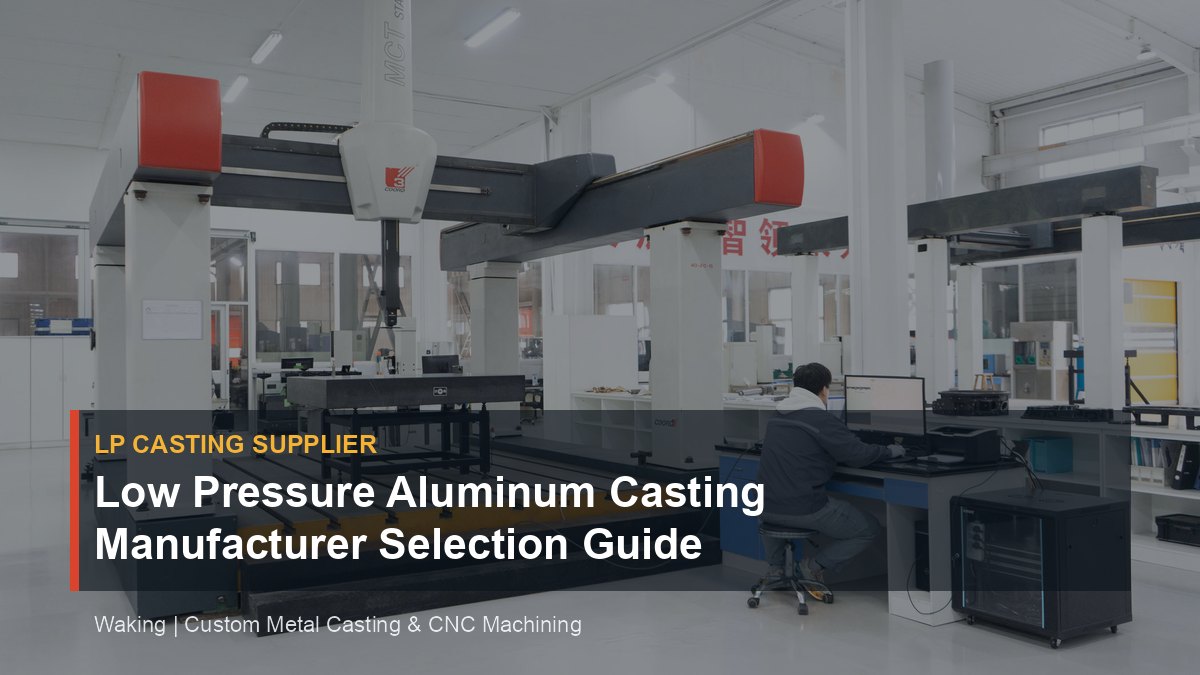
- CMMs. Coordinate measuring machines verify machined features and critical dimensions. Waking runs a COORD3 and a ZEISS SPECTRUM CMM. A supplier that says “we have CMM” but can’t name the brand is probably renting one for visits.
- Roundness and profile measurement. Relevant for bores, seats, and sealing surfaces on aluminum housings.
- Hardness testing. Confirms heat treatment consistency from batch to batch.
- Impact testing, including low-temperature. If your part sees cold service, ask for low-temperature impact testing specifically. Waking’s pendulum impact tester covers it.
- Portable measuring arms. Useful for large parts that don’t fit on a conventional CMM table.
Traceability is the piece buyers forget. For safety-relevant parts, you want batch traceability from melt to finished machined casting, with material certificates and inspection reports issued together. If the foundry can’t trace a finished part back to its heat, you have no recall path. Waking issues batch traceability with material certs and inspection reports as one package.
Test the engineering loop before you commit tooling
A foundry’s engineering strength shows up in how it answers a drawing. Waking’s workflow is simple: send drawings and requirements, get an engineering review and quote, then casting, machining, and delivery. The difference between suppliers is what comes back in step two.
A strong foundry comes back with questions. Which alloy and temper are specified? Where are the critical dimensions? Does this bore need a pressure test after machining? Are the wall sections castable as drawn, or will we need a draft angle change? A weak candidate comes back with only a number and a lead time.
Send the same drawing to three shortlisted suppliers. Compare the questions they ask. That is the cheapest supplier audit you’ll ever run.
Make sure the sample phase is formal. There should be a sample approval step before mass production and a first article inspection on the first production run. Waking does both. And be realistic about timing: every part is different, so confirm lead time and MOQ with the supplier for your specific part. A supplier who promises impossibly fast delivery is telling you it will miss the next deadline.
Build your shortlist around overlap
A supplier that already handles parts like yours will quote with fewer surprises. Waking’s low pressure aluminum work covers automotive and mechanical housings and industrial machinery components; its investment casting line handles pump and valve parts in 304, 316, CF8, and CF8M. That overlap reduces your technical risk.
The final shortlist should survive five questions:
- Is this the actual foundry, confirmed by live video and a machine count?
- Are casting, machining, and inspection all in-house?
- Can they prove internal soundness with X-ray and, where relevant, leak testing?
- Does the quality system match your industry — IATF 16949 for automotive, ISO 9001 for general industrial?
- Did their engineering team ask real questions about your drawing?
Answer yes to all five, and you have found a serious low pressure aluminum casting partner. Answer maybe to any of them, and keep looking. The part you save is more than money — it’s your production schedule.
Frequently Asked Questions
How do you verify that low pressure aluminum castings are internally sound before shipping?
Waking uses in-house X-ray NDT with an XTH320 system for internal defect screening, plus an inverted metallurgical microscope to check material structure. For pressure-containing parts, leak testing is included in the sample approval plan. First article castings should be x-rayed and leak tested, with reports shipped alongside samples.
What proof do you have that you are a real casting factory and not a trading company?
We operate a 70,000 m2 production base in Qingdao, founded in 2002, with casting, heat treatment, CNC machining, surface treatment and export packing all in-house. Live video walkthroughs of the casting line and machine lists are available on request. This integrated setup closes the feedback loop between casting and machining.
Why is in-house CNC machining important for low pressure aluminum casting quality?
When machining is done in the same factory, hidden porosity exposed during cutting is reported back to casting engineers the same day, so the same defect does not repeat in the next batch. Waking has 400+ CNC machines on site, so the same engineering team sees both the casting and the machined part.
How do you handle traceability for safety-relevant low pressure aluminum parts?
Waking issues batch traceability with material certificates and inspection reports as one package, so a finished machined casting can be traced back to its melt. This gives you a recall path if a defect is found. Put this requirement in the RFQ from day one.
Key Parameters at a Glance
| Parameter | Details |
|---|---|
| Factory location and size | Qingdao, China; 70,000 m2 production base; founded 2002 |
| In-house processes | Investment casting, low pressure aluminum casting, gravity aluminum casting, CNC machining, export packing |
| CNC machining capacity | 400+ CNC machines on the same site |
| X-ray NDT | XTH320 system for internal defect screening |
| CMM inspection | COORD3 and ZEISS SPECTRUM coordinate measuring machines |
| Metallurgical examination | Inverted metallurgical microscope |
| Pressure testing | Leak testing for pressure-containing parts |
| Hardness and impact testing | Hardness tester; pendulum impact tester including low-temperature impact |
| Certifications | ISO 9001 and IATF 16949 |
| Traceability | Batch traceability with material certificates and inspection reports |
| Materials | Stainless steel 304/316/CF8/CF8M; carbon steel; alloy steel; aluminum alloy |
| Surface treatments | Deburring, cleaning, polishing, anodizing, electroplating, passivation, coating, heat treatment |
