
Low pressure casting is the process behind many aluminum parts that go into modern vehicles: housings, brackets, structural components. If you buy aluminum castings for automotive use, the basic idea is simple. Molten aluminum alloy is pushed upward into a mold under low air pressure. The fill is steady, the metal solidifies under pressure, and the result is a denser, more repeatable part than gravity casting alone gives you. That repeatability is what automotive production depends on. This article covers the process, the risks, and what to check before you approve a supplier.
What Low Pressure Casting Actually Does
Low pressure casting sits between gravity casting and high-pressure die casting, and it borrows strengths from both. The mold is mounted above a sealed furnace. Low air pressure pushes molten aluminum alloy up a fill tube and into the cavity. Once the cavity is full, the pressure is held while the metal solidifies. That sustained pressure feeds the solidifying zones, which is what keeps shrinkage voids from forming.
Compared with gravity casting, the fill is slower and more controlled. Less turbulence means less trapped gas, better internal soundness, and fewer surprises at machining. Compared with high-pressure die casting, the tooling costs less and the parts are more ductile and can be heat treated. That combination makes low pressure casting a natural fit for aluminum housings and structural parts where strength, pressure tightness, and dimensional stability all matter at once.
From a buyer’s standpoint, the property that matters most is repeatability. Parts from the same tool should come off the line looking and measuring the same, from the first article to the ten-thousandth piece. Low pressure casting delivers that when the supplier controls the process closely. That “when” is doing a lot of work — the rest of this article is about how to verify it.
Why Automotive Housings Fit Low Pressure Aluminum
Aluminum weighs about a third as much as steel. Every kilogram saved improves fuel economy or electric range, so automakers keep moving parts from ferrous to aluminum. Housings are prime candidates: pump housings, valve bodies, gearbox and motor housings. These are parts that enclose moving components, bolt against gaskets, carry oil or coolant, and sometimes hold pressure.
That list of duties sets the quality bar. A housing that leaks, distorts, or fails in service is more than a scrap part — it can become a recall. Automotive buyers need a process that produces thin walls, complex internal geometry, and sound material, consistently. Low pressure casting handles thin walls and intricate cavities well, because the metal rises into the mold steadily instead of being dumped in. The controlled fill minimizes the turbulence that creates internal defects.
There is also the quality system around the process. Waking is certified to ISO 9001 and IATF 16949. IATF 16949 is the automotive quality management standard, and it is what automotive buyers expect from a casting supplier. If a supplier cannot show that certification, or something equivalent, pushing it through your qualification process will cost you time.
Porosity Is the Defect That Wastes Months
If you source aluminum castings for long, porosity becomes your least favorite word. Porosity is voids in the metal: trapped gas, shrinkage, or both. Low pressure casting is designed to minimize it, but no casting process eliminates it. The real question is whether your supplier looks for it.
Subsurface porosity is the dangerous kind. It hides below the surface until machining opens it up. Then you have a scrap part, a stalled line, or a pressure leak that shows up in testing. The way to catch it before it reaches you is X-ray inspection — and not every supplier has X-ray in-house.
Waking does. An XTH320 X-ray NDT system sits in the quality lab, screening for internal defects like gas holes and shrinkage voids. This is not a job sent to a third party; it is built into the casting workflow. Alongside X-ray, the lab uses an inverted metallurgical microscope to analyze material structure and a pendulum impact tester to verify impact performance, including at low temperatures. If your part lives in an engine bay, low-temperature impact behavior is not a footnote.
When you evaluate a supplier, ask what they inspect, not what they promise. What equipment do they use to find internal defects? What are the acceptance criteria? Is X-ray done on every part, or sampled from the batch? A factory-floor answer is worth more than a quality brochure.
Machining in the Same Factory Removes the Blame Game
Out of the mold, a casting is a rough part. Automotive housings need machined faces, bores, threaded holes, and sealing surfaces. If casting and machining are done by two different companies, the handoff becomes a source of friction. A subtle casting distortion shows up at the machine shop. The foundry blames the machining; the machine shop blames the casting. You stand in the middle with a delayed shipment.
Waking keeps casting and machining in the same factory. The CNC shop is not an external partner. More than 400 CNC machines are in-house, and parts move from the foundry to the machining line without leaving the facility. That removes the blame game and shortens the loop when a process adjustment is needed.
The same site handles the finishing steps that aluminum parts typically require: deburring, cleaning, polishing, anodizing, plating, passivation, coating, and heat treatment. Deburring deserves more respect than it gets. A burr left inside an oil gallery is a warranty claim waiting to happen.
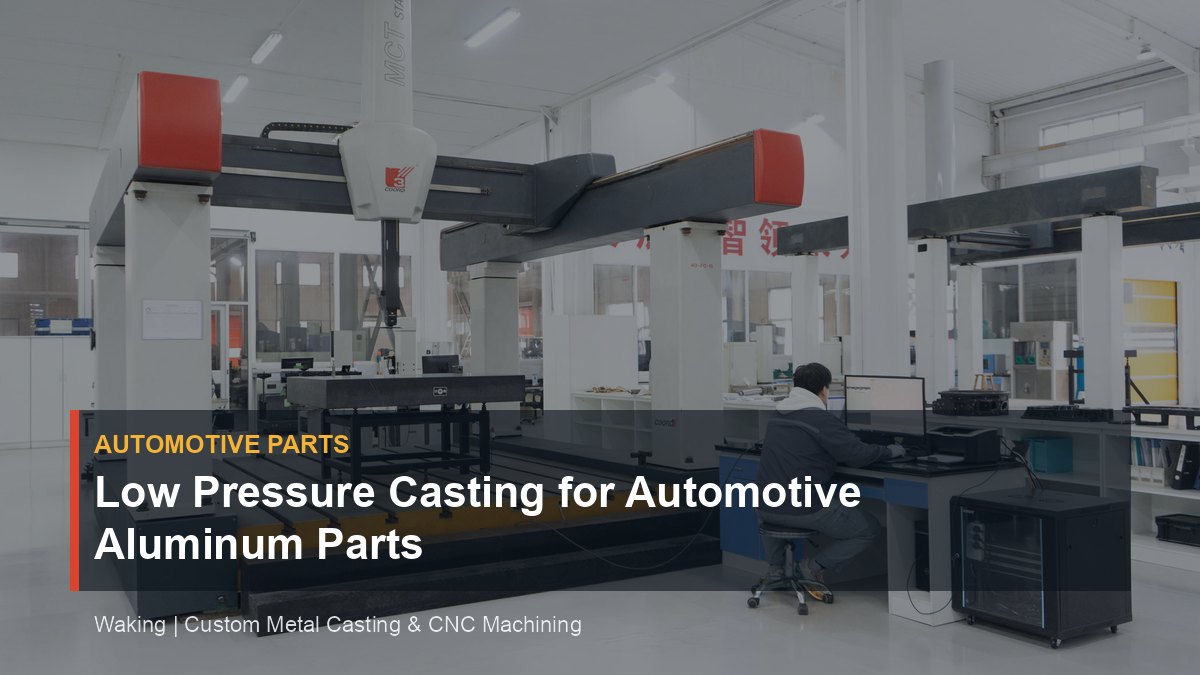
Then comes verification. The quality lab runs COORD3 and ZEISS SPECTRUM coordinate measuring machines, roundness and profile measuring equipment, and hardness testers. A portable measuring arm handles larger or awkward parts. For pressure-containing parts, leak testing is done before shipment. Casting, machining, finishing, and inspection under one roof — that is what “one responsible supplier” should mean.
Questions to Ask Every Low Pressure Casting Supplier
Waking has operated its production base in Qingdao since 2002 and exports to more than 40 regions. But you should not buy on a website; you should buy on answers. Run this shortlist past any supplier:
- Do you actually cast in-house? Waking is an operating foundry, not a trading company. Ask for a factory visit or a live video walkthrough. The production floor does not lie.
- What happens when I send a drawing? The process should be direct: send drawings and requirements, get an engineering review and a quote, then casting, machining, and delivery. The review matters. A supplier that talks about tooling approach, material choice, and machining allowances during quoting is doing engineering, not just filling in a price.
- What is your sample approval process? First Article Inspection and sample approval should happen before mass production. You want written evidence that the first parts match the drawing, agreed to on both sides.
- Where is the machining done? If it is subcontracted, ask who manages tolerances and who answers for scrap. In-house machining means fewer handoffs and clearer responsibility.
- What inspection equipment is in-house? Look for CMMs, X-ray, metallurgical analysis, hardness testing, and leak testing for pressure-containing parts. Vague answers are red flags.
- Can you trace a finished part back to its batch? Material certificates and inspection reports should come together with batch traceability. If a problem surfaces later, you need to know exactly which parts are affected.
- What is the realistic lead time and MOQ for my part? No honest number exists without a drawing. Send the drawing and expect a quick response and a realistic lead time — not a figure pulled from thin air.
Low pressure casting is a mature process. Maturity does not guarantee consistency, because the process is only as good as the controls around it. The difference between a dependable casting supplier and a source of rejects shows up in the details: the X-ray routine, the CMM reports, the deburring station, the leak test, the paperwork that ties a batch together. Buy from a factory that can show you all of it. That is how you turn a cast part into a reliable part.
Frequently Asked Questions
How does low pressure casting reduce porosity in automotive aluminum housings compared with gravity casting?
Low pressure casting fills the mold steadily from below under low air pressure, which creates less turbulence than gravity pouring and reduces trapped gas. Pressure is then held during solidification, feeding the solidifying zones and limiting shrinkage voids. This produces denser, more repeatable parts for housings and structural components.
What internal inspection methods should an automotive casting supplier use to catch subsurface porosity?
Subsurface porosity can hide below the surface until machining opens it up, so in-house X-ray inspection is critical. Waking uses an XTH320 X-ray NDT system for internal defects such as gas holes and shrinkage voids, supported by an inverted metallurgical microscope and pendulum impact tester. Buyers should ask about inspection equipment, acceptance criteria, and whether X-ray is done on every part or sampled from the batch.
Why does keeping casting and CNC machining in the same factory matter for aluminum automotive parts?
When casting and machining are split between suppliers, a subtle casting distortion can lead to a blame game and delayed shipments. Waking performs casting and machining in one facility with more than 400 CNC machines, plus finishing steps like deburring, anodizing, and leak testing. This shortens the loop for process adjustments and helps verify pressure-containing parts before shipment.
What quality certifications should a low pressure aluminum casting supplier hold for automotive programs?
Automotive buyers typically expect ISO 9001 and IATF 16949 certification from casting suppliers. Waking is certified to both and operates a quality lab with COORD3 and ZEISS SPECTRUM CMMs, roundness and profile measuring equipment, hardness testers, and leak testing. If a supplier cannot show equivalent automotive quality certification, qualification will take longer.
Key Parameters at a Glance
| Parameter/Feature | Description |
|---|---|
| Fill method | Molten aluminum alloy is pushed upward into the mold through a fill tube under low air pressure |
| Fill control | Steady, low-turbulence fill reduces trapped gas and internal defects |
| Solidification | Pressure is held while the metal solidifies, feeding solidifying zones to limit shrinkage voids |
| Wall thickness capability | Suitable for thin walls and complex internal geometry |
| Typical applications | Automotive housings, brackets, and structural aluminum components |
| Result | Denser, more repeatable parts than gravity casting alone |
