Phone:
+86 15005422253
Physical address:
Pingdu City, Qingdao,
Shandong Province, China.

Phone:
+86 15005422253
Physical address:
Pingdu City, Qingdao,
Shandong Province, China.
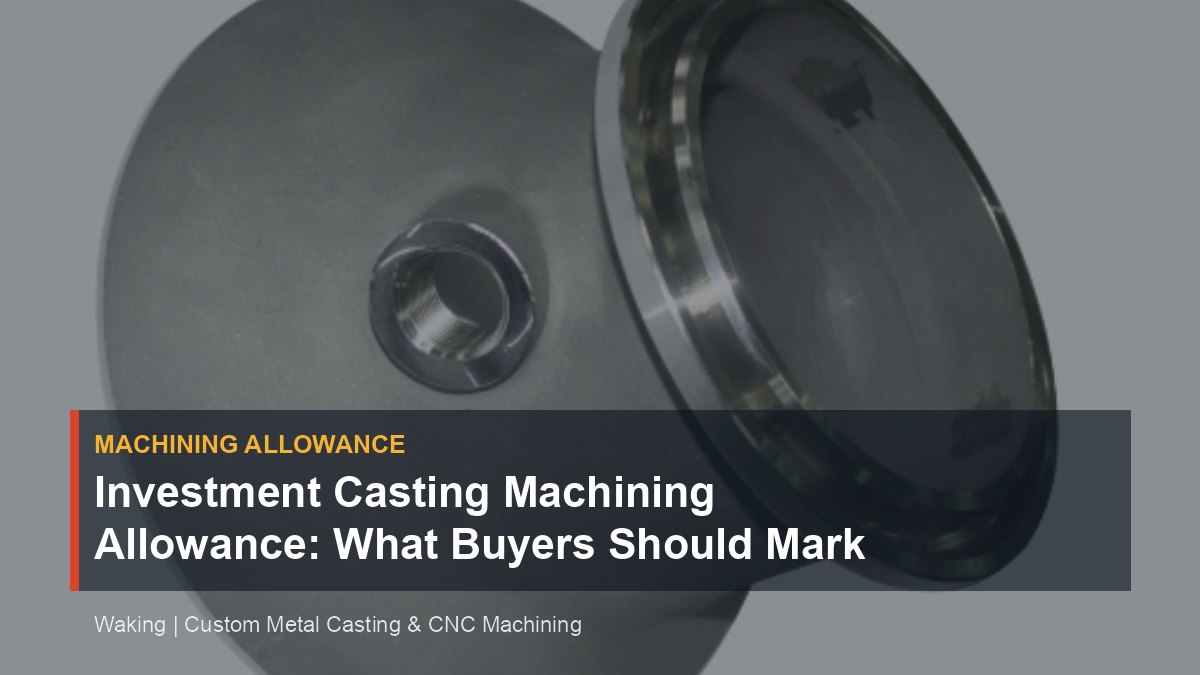
Plan investment casting machining allowance by marking datum surfaces, cleanup stock, machined faces, tolerances, inspection and RFQ assumptions.
When you send a drawing to an investment casting foundry, the machining allowance is one of the first things the engineering team reads. Get it wrong, and you either pay for metal you never needed or find out after the first machining run that the surface did not clean up. Buyers who mark this number properly get cleaner quotes and fewer surprises. This article explains what machining allowance is, how to mark it, and what to agree on before production.
Machining allowance is extra stock deliberately left on a cast surface so a later CNC pass can remove it and arrive at the final dimension. It is not a tolerance. A tolerance describes how much a dimension is allowed to vary. An allowance describes how much extra material sits on that surface for the tool to remove. They work together, but they are different things.
Take a simple example. Your final part calls for a 50.00 mm bore, and you specify a 1.0 mm per-side allowance. The casting is made with that surface around 52 mm, then machined down to 50.00. The casting tolerance controls how far the as-cast dimension may drift from 52. The allowance guarantees that even at the worst end of that drift, the tool still has material to cut. If the allowance is too small, a casting at the low end of its tolerance leaves nothing to machine — scrap before it starts.
Investment casting is a near-net-shape process, so allowances run smaller than in sand casting. Often you machine only the surfaces that matter: sealing faces, bores, threads, mounting pads. The rest stays as-cast. For small- and medium-size investment castings, allowances commonly land around 0.5 to 1.5 mm per side. Larger parts, or parts that distort during heat treatment, need more. As-cast surfaces need no allowance at all.
Waking runs its casting and machining in the same plant — own silica sol investment casting lines for stainless, carbon, and alloy steel, plus 400+ CNC machines. So the allowance is reviewed by the same team that later cuts the metal. Casting engineers and machinists settle on realistic numbers in one review instead of passing the problem back and forth.
The most common failure is not wrong numbers; it’s no numbers. Buyers send a final-part drawing with no mention of allowance and expect the foundry to guess which surfaces get machined and by how much. The foundry will guess, but the guess affects cost, lead time, and risk. Don’t leave it to a guess.
Three rules for your drawing:
One line on the drawing — “machining allowance 1.0 mm per side unless otherwise specified” — saves days of back-and-forth.
No single allowance fits every part. The right number depends on four things.
Part size and geometry. Long, thin castings distort during cooling and while being machined. Distortion eats into allowance. A small rigid part can get away with 0.5 mm per side; a long thin housing may need two or three times that to guarantee a clean cut along the whole surface.
Material. The stainless grades used in pump and valve work — 304, 316, CF8, CF8M — shrink and behave differently than carbon or alloy steel. A good foundry accounts for that in tooling and process design, but your allowance still needs to be realistic for the material. If you’re not sure, ask during the engineering review.
Heat treatment. Waking heat treats in-house, and sequence matters. If machining happens after heat treatment, the allowance must cover scale from the heat treat cycle plus distortion. If machining happens first, the allowance only covers the as-cast surface. Tell the foundry which sequence you need and let them confirm the allowance works for it.
Clamping. The machinist has to hold the part while cutting. Thin parts flex under cutting force. Enough allowance means the surface lands where it should after the part springs back, not where it sat while clamped.
Too much allowance is waste: more metal, more machine time, more tool wear. Too little is worse: the pass skims the surface and leaves casting skin, small pits, or porosity. You find out after the part is already in the machine — the most expensive time to learn it.
Machining exposes what sits under the cast skin. A small subsurface shrinkage that never mattered as-cast shows up as a pit on a machined face. On a cosmetic surface it’s ugly. On a valve body or impeller it can mean a leak.
Allowance and inspection are two halves of the same decision. If your part is pressure-containing, say so in the requirements. Mark the sealing faces. Ask how internal soundness will be checked before machining cuts into a defective casting.
At Waking, X-ray NDT with an XTH320 system screens for internal voids and shrinkage before machining starts. CMM inspection — COORD3 and ZEISS SPECTRUM machines — verifies the machined geometry afterward. Pressure-containing parts go through leak testing. Batch traceability ties the material certificate and inspection report to your parts.
The allowance tells the tool where to cut. Inspection tells you whether what’s underneath is worth cutting. Decide both before production, not after the first reject.
Waking’s process is simple: send drawings and requirements, engineering review and quote, then casting, machining, and delivery — all in-house. The review stage is where your allowance gets checked. A complete drawing package makes it fast and accurate.
Include in your package:
If you’re not sure about the allowance, don’t invent a number. Send the drawing and ask for an engineering review. A foundry with in-house machining will tell you what works — it carries the cost of a wrong allowance twice, once as scrap and once as consumed machine time.
Exact lead times and order minimums depend on your part’s geometry, material, and inspection level, so confirm them directly with the supplier for your specific part. A complete drawing with a clear allowance gets you a faster, more honest quote.
Waking has cast and machined in Qingdao since 2002: a 70,000 m² plant, ISO 9001 and IATF 16949 certification, exports to more than 40 regions. A real factory, not a trading company. Send them a drawing with a clear machining allowance, and the conversation starts at the right number.