Phone:
+86 15005422253
Physical address:
Pingdu City, Qingdao,
Shandong Province, China.

Phone:
+86 15005422253
Physical address:
Pingdu City, Qingdao,
Shandong Province, China.
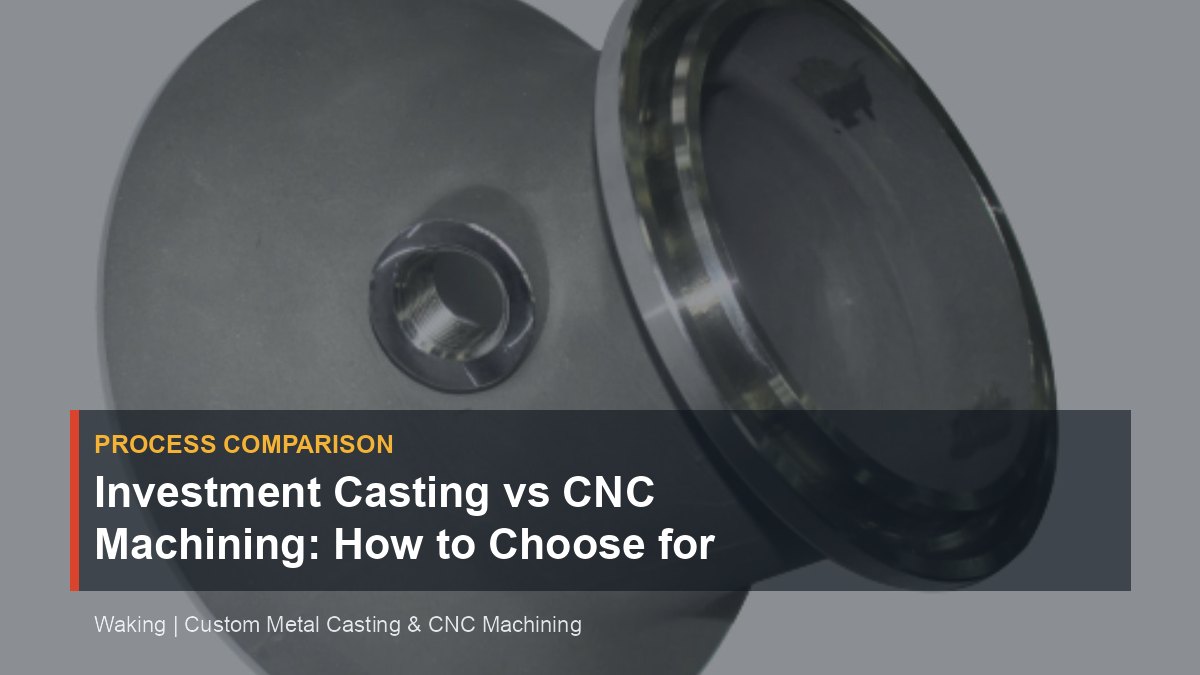
Compare investment casting vs CNC machining by geometry, volume, tooling, tolerance, material waste, lead time, machining allowance and inspection.
Investment casting and CNC machining solve different manufacturing problems. CNC machining removes material from solid stock and is strong for prototypes, tight final features and fast design changes. Investment casting forms a near-net metal shape from tooling and is strong for complex geometry, repeat production and reduced material waste. Many real parts use both: investment casting for the main shape and CNC machining for critical surfaces, threads, bores or sealing faces.
| Audit area | What a buyer should verify | How to check it |
|---|---|---|
| Geometry | Investment casting supports complex shapes and near-net forms. | Use CNC when tool access is simple or changes are frequent. |
| Volume | Casting improves when repeat volume justifies tooling. | Use CNC for one-off or uncertain designs. |
| Tolerance | CNC controls tight final dimensions better. | Cast loose geometry, machine critical features. |
| Material waste | Casting can reduce waste on complex shapes. | CNC may waste more stock but avoids casting tooling. |
| Design change | CNC changes are usually faster. | Casting changes can require tooling revision. |
A useful scorecard connects commercial discussion to factory reality. If the supplier cannot explain process choice, machining responsibility or inspection records, the quote may still be possible, but the buyer is accepting more risk than the price shows.
| RFQ item | Why it matters | Buyer note |
|---|---|---|
| 2D drawing | Dimensions, tolerances, datums, material notes and finish requirements. | Use the latest revision and mark critical features. |
| 3D file | Geometry for tooling, parting line, machining stock and assembly review. | STEP or similar neutral files are usually easier to review. |
| Material grade | Alloy choice, standard, heat treatment and report requirements. | Avoid common names when a formal grade is required. |
| Quantity plan | Prototype, first batch, annual demand and reorder pattern. | Separating sample and production volumes improves tooling decisions. |
| Machining scope | Threads, bores, sealing faces, datums and tight fits. | Clarify what is as-cast and what must be machined. |
| Inspection scope | Critical dimensions, material reports, surface criteria and functional tests. | Attach inspection expectations before sample approval. |
For Waking projects, buyers can start by reviewing lost wax casting service, CNC machining for cast components, Waking manufacturing capabilities, send drawings for process review. These pages give the RFQ conversation a clear path instead of leaving process, machining and inspection as separate topics.
| Mistake | Why it creates risk | Better practice |
|---|---|---|
| Choosing casting only for price | Tooling and sample risk may offset savings. | Compare full route cost. |
| Choosing CNC for every complex shape | Machining time and waste can become excessive. | Review near-net casting options. |
| Ignoring hybrid route | Buyer misses the best process combination. | Cast the form, machine the function. |
| No tolerance split | Supplier cannot know what must be machined. | Mark critical features clearly. |
Most sourcing problems begin before production. The drawing is incomplete, machining scope is assumed, inspection criteria are vague, or the supplier and buyer use the same word for different acceptance levels. The solution is not a longer email chain. The solution is a clearer RFQ packet and a supplier that is willing to question unclear details early.
Use this article as a working checklist, not as a one-time reading page. The buyer should first mark the non-negotiable requirements: material grade, annual quantity, critical dimensions, functional surfaces, inspection records and shipment conditions. Then compare each supplier response against those requirements. A supplier that gives a fast price but does not discuss process limits may still be useful for a simple part, but it should not be treated the same as a supplier that reviews drawings, machining stock and inspection evidence before quoting.
For production parts, the most important question is often not whether the supplier has a certain machine. The better question is how that machine fits the route from raw casting to approved shipment. A CNC machine does not solve a casting datum problem by itself. A quality certificate does not define which dimensions will be measured. A factory photo does not explain how a drawing revision is controlled. Buyers should turn every broad claim into a practical question: who checks this, when is it checked, what record proves it, and what happens if the sample does not match the drawing?
This is also where internal resources should be used deliberately. If the project is still at process-selection stage, review Waking’s capability and process pages before sending the RFQ. If the project has tight tolerances or mating surfaces, compare the machining scope with the inspection requirements. If the project is close to purchase approval, prepare the RFQ packet and use the related casting and CNC machining articles to check whether any DFM, quality or quoting details are missing. Before finalizing the RFQ, compare this requirement with CNC machining after casting guide, casting material selection guide, DFM checklist for custom cast parts so process selection, DFM, quoting and inspection stay aligned. The goal is to make the supplier response easier to compare, not simply longer.
Before the buyer sends the final RFQ package, someone should check that purchasing, engineering and quality are asking for the same result. Purchasing may focus on price and delivery, engineering may focus on fit and function, and quality may focus on inspection records. A casting project works better when those requirements are visible in one packet. If one department keeps a requirement only in email, the supplier may miss it during tooling, sampling or shipment preparation.
For repeat orders, keep a short record of what was learned from the first sample: drawing notes that caused questions, dimensions that needed tighter control, packaging details that protected machined surfaces, and reports the buyer actually used. That record makes the next RFQ faster and gives the supplier a clearer target for stable production.
| Timing | Action |
|---|---|
| Before RFQ | Collect drawings, CAD, material, quantity, finish and inspection notes. |
| Before tooling | Confirm DFM feedback, process choice, tooling assumptions and sample approval plan. |
| Before samples | Agree on report format, measured dimensions, surface criteria and packaging. |
| Before production | Freeze drawing revision, tolerance interpretation, delivery terms and change-control rules. |
| Before shipment | Check inspection records, material documents, labels, packaging and invoice details. |
CNC machining usually controls tight final dimensions better, while investment casting can produce detailed near-net geometry that may still need machining.
CNC can be faster for prototypes and design changes. Investment casting usually needs tooling and sample time before production.
It can reduce machining but rarely replaces all CNC work when threads, bores, sealing faces or tight fits are required.
Compare geometry, volume, material waste, lead time, tolerance priorities, tooling cost and whether a hybrid casting-plus-machining route is better.