
If you buy cast parts for production, the first question is not price. It is whether your casting manufacturer can deliver the same quality from the first article to the last shipment. That question gets harder when your supplier sits on the other side of the world. We run a custom casting factory in Qingdao, China, and we have watched buyers pick suppliers on the strength of a website, then spend months fighting porosity, missed tolerances, and shipping delays. Most of those problems trace back to one mistake: choosing a middleman when they thought they were choosing a foundry.
This guide covers what production buyers actually need to check before committing to a casting manufacturer. It is written from the factory floor, not the sales office.
A casting manufacturer is not a trading company
The first thing to verify is whether the company you are quoting actually owns a foundry. Plenty of “casting companies” are trading companies. They take your drawing, shop it around, and quote you the lowest bid plus a markup. You end up two steps away from the process, with no direct control over the plant that pours your parts.
A real casting manufacturer owns its core process. Waking has been a production facility in Qingdao since 2002, with a 70,000 square-meter base. Investment casting, low-pressure aluminum casting, and gravity aluminum casting all happen on site, and so does CNC machining. More than 400 CNC machines run inside the facility, owned rather than outsourced. That last point matters more than most buyers realize. When machining is handed to a third party, tolerance control splits across two companies with different priorities. When the foundry and the machine shop share a floor, one team answers for the whole part.
So how do you check? Ask for an equipment list. Ask who operates the machines. Ask who signs the inspection reports. Ask for a live video walkthrough if you cannot visit. Vague answers are a red flag. And check the certificates: ISO 9001 and IATF 16949 mean the plant runs a formal quality management system. The IATF certificate is a strong signal for automotive buyers—it brings automotive-grade discipline to the whole factory, not just one product line.
Waking exports to more than 40 regions, and the factory holds both certifications. But the certificates are not the point. The point is that you can verify them, and you should.
Match the casting process to your part
Different parts need different processes. A serious casting manufacturer should be able to explain the options and recommend one honestly. Here are the three processes we run, and when buyers typically use them.
Investment casting, also called lost wax casting, uses a silica sol shell. It handles stainless steel, carbon steel, and alloy steel. It suits parts with complex geometry and tighter features because the pattern can replicate detail that sand or permanent mold methods would struggle with. It is also efficient for stainless steel casting because it produces close-to-final shape, which reduces machining time on hard alloys.
Low-pressure aluminum casting fills the mold from below under controlled pressure. It is a good fit for automotive and machinery housings where the fill pattern needs to be consistent from part to part.
Gravity aluminum casting is the more direct approach: molten aluminum is poured into the mold by gravity. It is a practical, economical route for many housings, brackets, and industrial parts.
For production buyers, the lesson is this: do not let a one-process job shop force your part into its single capability. Send the geometry and the performance requirements, and let engineering review help you choose the process. If your part is a valve body or an impeller, the conversation is even more specific. Those parts are often specified in 304 or 316, and in casting form they come as CF8 or CF8M. More on that next.
Cast grades are different from wrought grades
This is where many RFQs go sideways. A design engineer writes “316 stainless” on the drawing. The foundry pours CF8M, which is the cast counterpart of 316. If the drawing says 304, the cast counterpart is CF8. The chemistry is similar, but the structure is different because one is cast and the other is worked. If the drawing and the purchase order do not state the cast grade, the foundry has to make a judgment call. That is not how you want critical materials decided.
Here is what a casting manufacturer should be able to confirm for every order: the exact cast grade, the chemistry that will be poured, and the material certificate that goes with the batch. At Waking, the stainless program is built around 304, 316, CF8, and CF8M. Carbon steel and alloy steel are also available. For aluminum, the program covers aluminum alloy castings for automotive, housing, and industrial machinery applications.
For pump and valve parts, this matters daily. Valve bodies and impellers carry pressure and fluid, so the material spec has to be exact on the drawing. Ask the foundry to state the cast grade it will pour, and ask for batch traceability. Material certificates and inspection reports should come from the same batch for the same part.
Inspection equipment decides whether quality control is real
Any foundry can claim strict quality control. A real foundry can name the machines. Because casting defects such as porosity and shrinkage live inside the metal, you need more than a visual check. You need equipment that can see inside the part and measure it accurately.
Here is what a fully equipped casting manufacturer should have, and what each piece of equipment does for your parts:
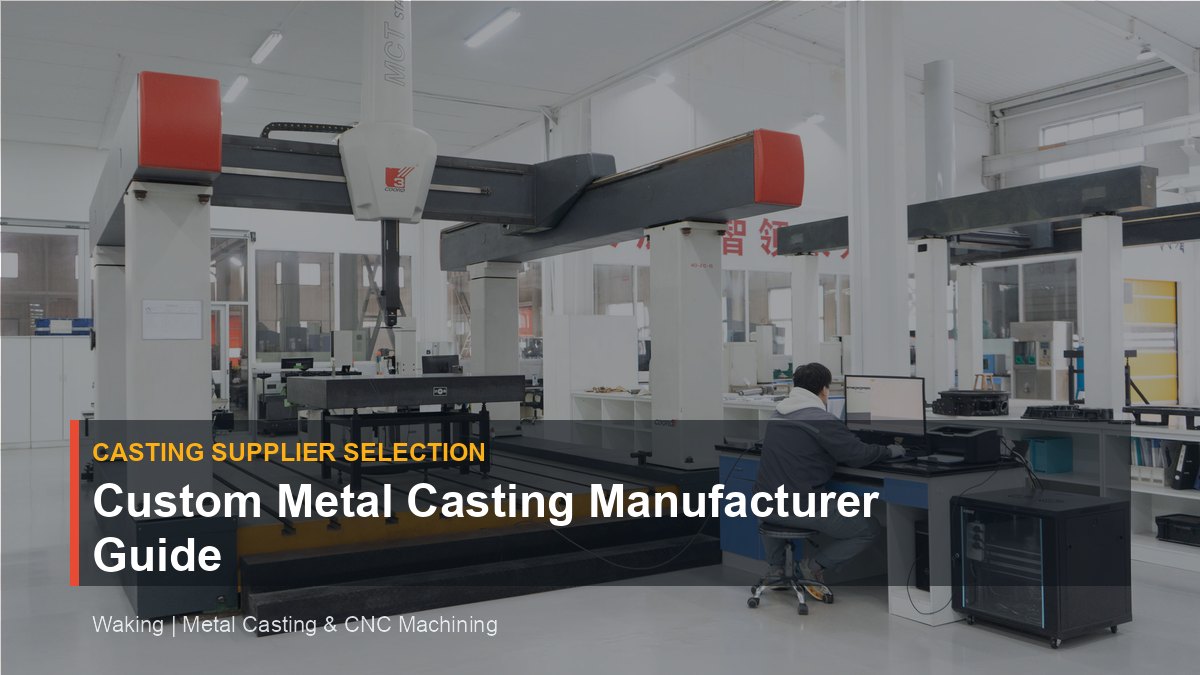
- Coordinate measuring machines (CMM). Two units on site—a COORD3 and a ZEISS SPECTRUM. These verify critical dimensions and confirm that the casting matches the drawing within tolerance.
- X-ray NDT. The XTH320 system inspects internal defects such as porosity and shrinkage. For pressure-containing parts, this is the difference between catching a problem in the factory and finding it after installation.
- Metallurgical microscope. The inverted type is used to check material structure and confirm the metal was poured and cooled the way it should be.
- Roundness and profile measurement, plus hardness testers. These cover geometric features and basic mechanical property checks.
- Pendulum impact tester. Capable of low-temperature impact testing. If your part operates in cold environments, this proves the material will not turn brittle.
- Portable measuring arm. Useful for checking larger parts on the shop floor without tying up the CMM.
Then there are the process checks that should be standard: first article inspection before serial production, sample approval before shipment, and leak testing for pressure-containing parts. For valve body castings and housings that hold pressure, ask the foundry directly how leak testing is performed. If the answer is vague, treat it as a warning. Leak testing should be built into the production flow for pressure-containing parts, not treated as a special favor.
Traceability ties it all together. Ask for batch-level traceability, with material certificates and inspection reports issued together. When something goes wrong later, you need to know exactly which batch was affected.
Send the right package and the quote gets faster
The process at a serious casting manufacturer follows three steps. You send drawings and requirements. Engineering reviews and quotes. Then casting, machining, and delivery follow in sequence. The more complete your first submission, the fewer round trips the quote takes.
Here is what to include:
- The full drawing, with critical dimensions clearly flagged.
- The material spec, including the cast grade if you know it.
- Annual volume and expected order frequency.
- Surface finish requirements.
- Leak test or pressure test requirements on the drawing, not buried in a separate email.
- Any third-party inspection or certification requirements.
Buyers who send partial information get hedged quotes. A hedged quote is worse than a slow one, because it does not tell you what the part will actually cost. A manufacturer who asks pointed questions about your critical dimensions is doing you a favor. The ones who quote without questions are pricing the vague version of your part.
On lead time and MOQ: ignore the template answers. Confirm exact lead time and MOQ with the supplier for your specific part. Every part has different tooling considerations and process steps. A real factory will give you a realistic lead time, and a quick response to your drawings and quotation request is a fair expectation.
Pick a casting manufacturer the way you would pick a machining partner. Verify the facility. Check the equipment. Push the engineering team with questions. The foundry that names its inspection machines, confirms its cast grades, and answers your drawing questions clearly is the one that will deliver your parts. The others are just trading your requirements to the lowest bidder.
Frequently Asked Questions
How can I confirm that a supplier is an actual casting manufacturer and not a trading company?
Ask for an owned equipment list, request who operates the CNC machines and who signs inspection reports, and ask for a live video walkthrough if you cannot visit. Verify that the foundry holds ISO 9001 and IATF 16949 certificates. At Waking, investment casting, low-pressure aluminum casting, gravity aluminum casting and over 400 CNC machines are all on the same Qingdao site.
The drawing says 316 stainless steel, but the quotation lists CF8M. Is that correct?
Yes, CF8M is the cast counterpart of 316, just as CF8 is the cast counterpart of 304. The chemistry is similar but the structure differs because the material is cast rather than wrought. Require the foundry to state the exact cast grade and provide batch-traceable material certificates.
Which casting process should I request for a stainless steel valve body or impeller?
Investment casting, or lost wax casting, is usually the best fit for stainless steel valve bodies and impellers because the silica sol shell process reproduces complex geometry and produces a close-to-final shape that reduces machining on hard alloys. The final choice should come from an engineering review based on your drawing, but Waking runs investment casting, low-pressure aluminum casting and gravity aluminum casting in one facility.
What inspection equipment should a production foundry have to catch internal casting defects before shipment?
A real foundry should be able to name its machines. Waking uses COORD3 and ZEISS SPECTRUM CMMs for dimensional verification, XTH320 X-ray NDT for internal porosity and shrinkage, plus hardness, impact, roundness/profile and leak testing for pressure-containing parts. X-ray NDT is critical for parts like valve bodies and impellers where internal defects cannot be found visually.
Key Parameters at a Glance
| Process / Capability | Materials | Typical Applications | On-Site Verification |
|---|---|---|---|
| Investment casting (silica sol lost wax) | 304/316/CF8/CF8M stainless steel, carbon steel, alloy steel | Complex parts such as valve bodies and impellers | CMM, X-ray NDT, batch material certificates, FAI |
| Low-pressure aluminum casting | Aluminum alloy | Automotive and machinery housings | CMM, X-ray NDT, leak testing for pressure parts |
| Gravity aluminum casting | Aluminum alloy | Housings, brackets, industrial parts | CMM, X-ray NDT, FAI |
| CNC machining (on-site) | Castings requiring machined features and tight tolerances | Finished cast parts from the same factory | CMM dimensional inspection shared with foundry floor |
