Phone:
+86 15005422253
Physical address:
Pingdu City, Qingdao,
Shandong Province, China.

Phone:
+86 15005422253
Physical address:
Pingdu City, Qingdao,
Shandong Province, China.
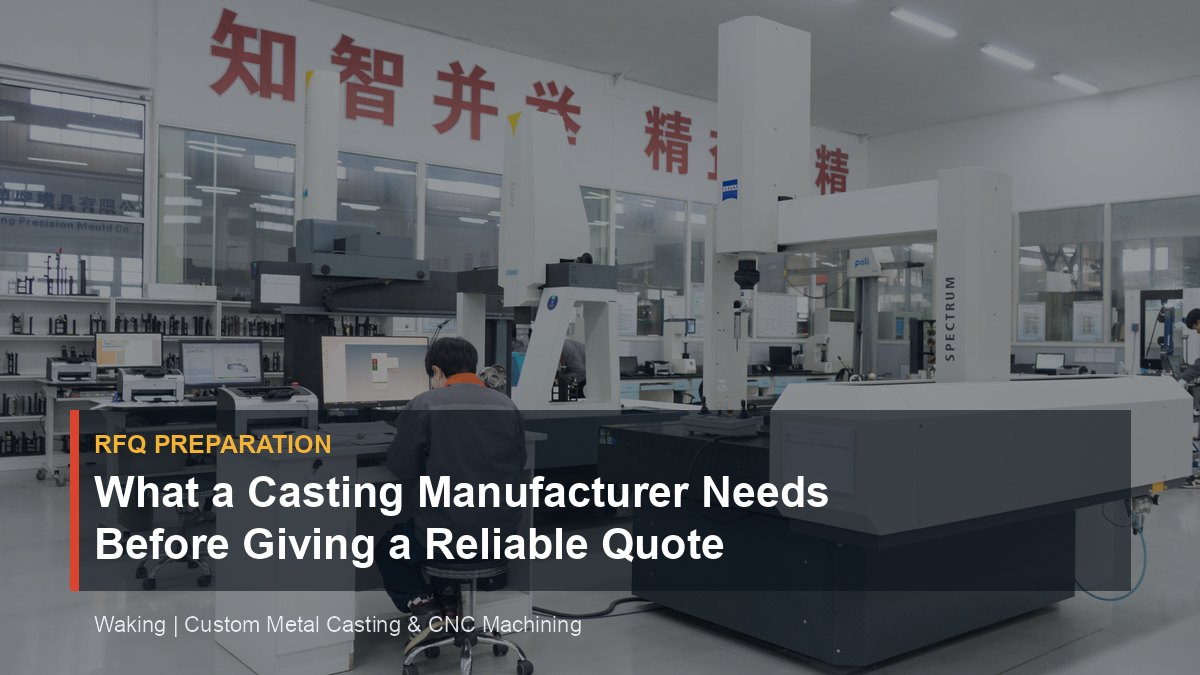
Prepare casting quote requirements with drawings, material grade, quantity, machining scope, finish, inspection, packaging and delivery expectations.
When you send a drawing to a casting manufacturer, the quote you get back is only as good as the information you sent with it. A complete inquiry gets you an accurate price quickly. A vague one gets you questions, delays, and a number padded to cover uncertainty. At Waking, a real casting factory in Qingdao, China, our engineers review RFQs every day. The difference between the fast ones and the drawn-out ones is consistent. Here is what a casting manufacturer actually needs before it can quote your part properly.
A casting leaves the mold with as-cast surfaces. Machined surfaces come later, after the part is extracted and cleaned. These two surface types have very different tolerances and very different costs. If your drawing doesn’t show which is which, we have to guess.
Mark the machined surfaces on the drawing. Mark the critical dimensions — the ones that matter for assembly and function. If you don’t mark them, one of two things happens. We quote tight tolerances everywhere and you overpay. Or we assume commercial tolerances and the part doesn’t fit when it arrives. Neither outcome makes you happy.
If you use GD&T, include it. Datums and profile tolerances tell the inspector what to check and how to set up the CMM program. If you don’t use GD&T, that’s acceptable — but tell us which surfaces are functional. During the engineering review, our engineers will flag anything ambiguous before the quote becomes final. That is exactly what the review is for.
Surface finish matters too. As-cast finish depends on the process — investment casting for steel, low pressure or gravity casting for aluminum — and on the material. If a surface must be smooth for sealing or fluid flow, specify the finish. Otherwise you receive a functional part with a rough seal face, and you blame the supplier for something that was never quoted.
“Stainless steel” is not a material specification. Neither is “aluminum.” Give us a grade, or give us the service conditions and let us recommend one. Both work. The buyer who stays silent slows everything down.
At Waking, the stainless grades we cast are 304, 316, CF8, and CF8M. Carbon steel and alloy steel cover a wide range of industrial machinery parts. Aluminum alloys serve the low pressure and gravity casting lines for automotive and housing work. Each grade has a different cost and different casting behavior. CF8M costs more than CF8 because the molybdenum buys real corrosion resistance. The grade drives the price.
But the grade is half of it. We also need to know what the part does. Is it a valve body handling a corrosive process fluid? A pump impeller moving water? A housing that sees vibration, heat, and road salt? A pressure-containing part needs material integrity checks and leak testing. A structural part needs mechanical property verification. A decorative cover needs a clean surface and little else.
If you don’t know the grade, answer the service questions. A reliable casting manufacturer will recommend a material. What kills a quick quote is an engineer who says “make it like the last one” when no one can find the last one.
Porosity and shrinkage are the two casting defects every buyer should know. Both happen inside the metal, where nobody can see them. Whether they matter depends on the application, and only you know that.
For a pump or valve body, internal porosity can mean a leak under pressure. For a structural bracket, it can mean failure under load. For a non-critical housing, it may not matter at all. We need to know which category your part falls into before we quote, not after.
If the part holds pressure, the quote must include leak testing and X-ray inspection. At Waking, our quality lab runs an XTH320 X-ray system for internal defect detection, plus leak testing for pressure-containing parts. Our CMM machines — a COORD3 and a ZEISS SPECTRUM — verify dimensions. An inverted metallurgical microscope checks material structure. A pendulum impact tester verifies toughness, including at low temperature. Our quality system is certified to ISO 9001 and IATF 16949.
None of that helps you if we don’t know the requirement. Quote a valve body without mentioning pressure testing, and the price is low and the plan is wrong. Add the testing requirement later, and the price rises and the lead time stretches. Requirements stated on the first day produce a reliable quote. Requirements discovered later produce change orders.
Casting is not machining a single billet. Tooling, gating design, process trials, and first article inspection all happen before production parts ship. Those costs are spread over the order volume. So the annual quantity and the order pattern directly change the unit price.
Do not ask for a quote on “prototype first, mass production later” without a sense of scale. A part consumed in dozens per year and the same part consumed in thousands per year are two different jobs. The tooling, the gating, the inspection plan, and the machining setup may be identical — the unit cost is not. Give us a range if you have one. If you truly don’t know yet, say so, and expect the quote to be built on assumptions you will need to confirm.
Be realistic about lead time. Every buyer wants parts yesterday. A serious casting manufacturer gives a delivery date based on the drawing, the material, the inspection content, and the machining content — not on what you hope to hear. At Waking, our process is three steps: you send drawings and requirements; we do the engineering review and quote; then we move to casting, machining, and delivery. The engineering review exists precisely to give you a lead time you can plan around.
If your project has a fixed deadline, state the date in the first message. If you don’t, the quote will assume normal scheduling. A surprise expedite request later means extra cost, because someone else’s work has to move aside.
Export packaging is part of the job here, too. If your parts are heavy valve bodies going by sea freight, tell us. Shifting from standard cartons to reinforced crates changes both cost and damage risk.
Waking is a real casting factory, not a trading company. We have a 70,000 m² production base in Qingdao, established in 2002, exporting to more than 40 regions. That matters because the quote has to survive contact with the factory floor. In a trading company, the quote is a margin calculation on someone else’s capacity. In a factory, the quote is a plan for what our own operators, machines, and inspectors will do.
During the engineering review we choose the process — investment casting for stainless and alloy steels, low pressure or gravity casting for aluminum. We decide whether the part needs heat treatment, deburring, polishing, passivation, or coating. We select the inspection equipment from our own lab. We calculate the machining workload on our own 400+ CNC machines. Every one of those decisions changes the number on the quote. This is why a reliable quote cannot come from a screenshot of a 3D model. It comes from reviewing a complete package.
Before you send your next RFQ, check for these five items. Complete drawing with tolerances and machined surfaces marked. Material grade stated, or service conditions described. Application noted, including pressure and safety requirements. Volume and delivery target given. Inspection and documentation needs listed. When all five are there, the quote is fast and dependable. When some are missing, expect questions. The questions are not a delay tactic. They are how a serious casting manufacturer makes sure the price you get is the price you can work with.