
When you compare quotes for cast metal parts, casting surface finish is one of the first things you look at. Sand blasting is the most common step a foundry uses to deliver that finish. It is also the most misunderstood. Some buyers assume blasting cleans up a bad casting, closes porosity, or improves dimensional accuracy. It does none of those things. This article explains what the process actually does, what it definitely does not fix, and what you should ask before you put “sand blast” on a drawing.
What sand blasting actually does
Sand blasting propels abrasive media at the casting using compressed air or centrifugal force. The media can be sand, steel grit, glass beads, or aluminum oxide, depending on the alloy and the result you need. The job is strictly surface-level.
On a part that has just come out of the mold, blasting removes:
- residual mold sand and scale
- flash and thin fins
- heat treatment scale and oxidation
- light surface rust from storage
- organic residue and release agents
What remains is a clean, uniformly textured surface with a matte appearance. That texture is useful: it gives paint and other coatings something to grip. A smooth, bright surface requires machining and polishing after blasting. Blasting alone does not produce one.
Think about it this way. Blasting cleans the surface and changes its roughness profile. It does not change the shape of the part. Material removal happens, but it is not controlled or measured. No competent engineer uses blasting to fix a dimensional problem. If a casting came out of the mold oversize, it will still be oversize after blasting.
What sand blasting does not fix
Every foundry sees buyers who hope blasting will solve a deeper problem. It will not.
Porosity and shrinkage are internal conditions. They form during solidification, when gas or voids get trapped inside the metal. Blasting works from the outside. It cannot reach a pore below the surface. In fact, an aggressive blast can peen a shallow surface pore shut, smearing metal over it. The defect is still there. It typically reappears later — during machining, pressure testing, or in service. That is the worst outcome for a buyer: a part that looks right and fails where it matters.
Cracks are another condition blasting cannot address. A surface-breaking crack may be hidden temporarily by blasting residue or a peened layer. It is still a crack.
Internal soundness is verified before surface treatment, not after. A casting supplier that takes quality seriously checks the raw material while it is still raw. This is where X-ray inspection belongs. At Waking, the in-house X-ray NDT system (the XTH320 unit) screens castings for internal porosity and shrinkage before they move down the line. The X-ray image tells you what blasting never can: whether the inside of the part matches the outside.
When blasting is the right call
Sand blasting earns its place in three situations.
Before coating. Paints, anodizing, and plating need a clean, slightly roughened surface to bond to. If your part will be coated, specify blasting as the prep step.
After heat treatment. Heat treatment scale is hard, brittle, and ugly. Blasting removes it efficiently. If your castings are heat treated — and most stainless and alloy steel castings are — blasting is the standard way to bring the surface back to clean metal.
Cosmetic uniformity. Castings accumulate batch-to-batch variation: mold temperatures, shakeout times, handling differences. Blasting evens that out into one consistent industrial finish. For pump and valve parts that will be seen, that consistency matters.
Blasting is the wrong call in other situations. Thin-walled parts can distort under high blast pressure. Soft aluminum erodes quickly if the media is too aggressive. Stainless steel can be contaminated by iron-based blast media, which then rusts. A competent supplier selects media and pressure for the alloy, not for the price list.
And if the real goal is a smooth bearing surface, a sealing face, or a precise mounting dimension, blasting is not the answer — machining is. A foundry with in-house CNC, like Waking with more than 400 machines on site, finishes critical surfaces with cutting tools, not abrasives. Blasting prepares the surface for what comes next; it does not replace it.
What to ask your supplier
“Sand blast” on a drawing tells a foundry almost nothing. It is a loosely defined step. Ask these questions instead:
- What media will be used? Steel grit, glass beads, and aluminum oxide produce different surfaces. Some media are too aggressive for thin sections.
- What is the purpose? If the goal is coating prep, say so. If the goal is cosmetic, say so. The supplier can then choose the right grade for the job.
- Will the surface be cleaned after blasting? Blast media can become embedded in the metal. On stainless steel, embedded carbon steel grit causes rust spots. On parts that will be passivated or coated, embedded contamination is a defect.
- How is the finish grade defined? Blasted texture is compared against standard visual comparators. Ask what your supplier is working to and whether they can hold it across a production run.
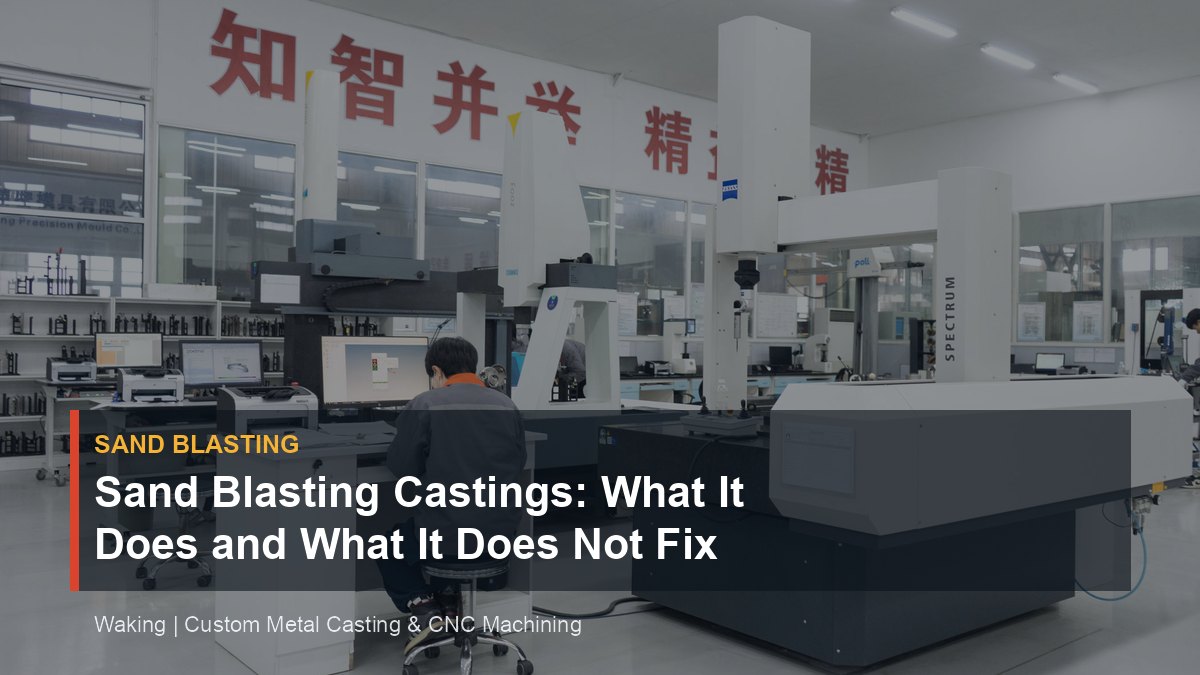
- How is internal soundness verified? This question separates a casting supplier from a surface finisher. Blasting makes a part look finished. X-ray inspection tells you whether it is sound underneath. CMM inspection tells you whether it is dimensionally correct. Waking runs both in-house — X-ray on the XTH320, CMM on COORD3 and ZEISS SPECTRUM units. Ask to see evidence of both.
- Is your part pressure-tight? For valve bodies and pressure-containing castings, leaks are settled by leak testing, not by looking at the surface. Waking performs leak testing on pressure-containing parts. Ask any supplier what their equivalent process is and how they report results.
If your contract calls out casting surface finish, define it by purpose and verify it by inspection. Surface treatment is not quality assurance. Good surface work makes a sound casting look as good as it is. It cannot make an unsound one look better — not for long, anyway.
Frequently Asked Questions
If my casting has internal porosity or shrinkage, will abrasive blasting close the defect or hide it before machining?
No. Abrasive blasting acts only on the outside surface and cannot reach internal porosity or shrinkage. Aggressive blasting may temporarily peen over a shallow surface pore, but the defect remains and typically reappears during machining, pressure testing, or service. Internal soundness should be verified before blasting, for example by in-house X-ray NDT on a unit like the XTH320.
Can blast finishing correct an oversize casting or improve dimensional accuracy?
No. Blast finishing removes material in an uncontrolled, unmeasured way and does not change the part shape. An oversize casting remains oversize after blasting. Dimensional accuracy is verified with CMM inspection, not by blasting.
For stainless steel castings, what should I check about blast media and post-blast cleaning?
Stainless steel can be contaminated by iron-based blast media, which later rusts, so media must be selected for the alloy and post-blast cleaning is required. Specify whether the part will be passivated or coated, because embedded contamination becomes a defect. Ask the supplier what media will be used and how the surface is cleaned after blasting.
When is abrasive blasting the right preparation step, and when should it be replaced by machining?
Blast finishing is appropriate before coating, after heat treatment to remove scale, and for cosmetic uniformity. It gives a clean, slightly roughened matte surface that helps coatings bond, but it does not produce smooth bearing surfaces, sealing faces, or precise mounting dimensions. For those critical surfaces, CNC machining is required, not blasting.
Key Parameters at a Glance
| Condition or requirement | Can abrasive blasting address it? | Inspection or control method |
|---|---|---|
| Remove residual mold sand, heat treatment scale, flash, light rust, organic residue | Yes | Visual cleanliness and surface finish comparator |
| Fix oversize dimensions or improve shape accuracy | No | CMM inspection (COORD3 and ZEISS SPECTRUM) |
| Close internal porosity or shrinkage | No | X-ray NDT (XTH320) |
| Confirm pressure tightness of valve bodies | No | Leak testing |
| Prepare surface for coating | Yes | Surface finish comparator; coating is a separate qualified process |
