
When a buyer specifies CF8M, they’re asking for a specific type of stainless steel casting — one that carries molybdenum, resists pitting, and has a long history in pump and valve work. That grade choice matters because the application usually does too: a valve body that corrodes from the inside is not a warranty claim, it’s a shutdown. This article covers what CF8M is, when it’s the right call, what a foundry has to control to pour it correctly, and how to verify you actually got what you ordered.
What CF8M Is, and Why the Name Matters
CF8M comes from the ACI casting designation system, used because cast stainless steels are certified differently from wrought forms. Order a part machined from 316 bar and you get a wrought product. Cast the same part and the foundry certifies it against the cast designation instead. CF8M is effectively the cast counterpart of 316. The M in the name signals molybdenum — the element that separates it from CF8, the cast counterpart of 304.
Why does that difference matter to a purchasing manager? Because molybdenum changes how the material behaves in service. A 304-type grade resists general rusting well. But chlorides — saltwater, bleach, brine, process chemicals — attack it over time. Molybdenum lifts the material’s resistance to pitting and crevice corrosion in exactly those environments. That’s why CF8M shows up so often in pump and valve bodies, impellers, and fittings that handle seawater or aggressive media.
There’s a cost side too. Molybdenum makes the alloy more expensive, so CF8M costs more than CF8 per unit of melt. Nobody should pay for it on a part that lives in a dry, benign spot. But a part that fails in service costs far more than the material upgrade — in rework, downtime, and lost customer confidence. Choose the grade based on the service, not the habit.
When CF8M Is the Right Specification
In our shop, CF8M and its stainless cousins appear most often in pump and valve work: valve bodies, impellers, and housings that carry water, chemicals, or steam. We also see it in industrial machinery parts where corrosion resistance and mechanical strength have to meet in a single cast component. Those are the jobs where specifying CF8M is usually correct.
Think twice before specifying it for parts that never face corrosion. Simple brackets, housings, and non-pressure components can often be cast in carbon steel or alloy steel at a lower cost. And if conditions are mild, CF8 may be enough. The conversation that settles it is simple: what is the media, what is the temperature, and does the part hold pressure? Answer those three questions before you put a grade on the drawing.
One more thing worth saying: don’t write “stainless steel” on a drawing and stop there. That phrase doesn’t tell the foundry whether you need CF8, CF8M, or something else. The more precisely you specify, the fewer surprises you get in both the quote and the inspection report.
What a Foundry Has to Control When Casting CF8M
CF8M is investment-castable, and for a stainless steel casting that has to hold pressure, it’s the most common route. Waking casts it using silica sol lost wax casting — the same line used for our other stainless, carbon steel, and alloy steel parts. Investment casting gives near-net-shape geometry, which matters for a valve body with internal flow passages. Less machining means less cost and less risk of opening up a hidden defect.
But the casting process is where problem parts are born. Shrinkage porosity and micro-porosity form inside thick sections if the foundry doesn’t control solidification. You can’t see those defects from the outside. A part can look perfect and still leak under pressure. So what separates a good CF8M supplier is not whether they have a melting furnace — nearly everyone does. It’s what they do before, during, and after the pour.
Heat treatment is part of that answer, and so is machining. Waking treats heat treatment as a standard step and machines castings in-house rather than shipping them out to a third party. That sounds like an operational detail, but it has a practical effect: when one factory controls the part from wax to finished bore, the dimensional report actually means something. Waking’s plant in Qingdao runs casting and CNC machining under one roof on a 70,000-square-meter site, with more than 400 CNC machines, and has done so since 2002.
Waking is also a real factory, not a trading company. It holds ISO 9001 and IATF 16949 certifications and exports to more than 40 regions. That matters when you’re buying a pressure-containing part from an overseas supplier. You want the manufacturer’s name — not a middleman’s — on the material certificate.
How to Verify the CF8M Castings You Receive
The honest answer to “how do I know it’s really CF8M?” is that you verify it the same way the foundry does: check the material, check the inside, check the dimensions, and check it under pressure.
Here’s what Waking’s inspection room includes, and what you should ask any supplier about:
- Material identity and traceability. Every heat should be traceable back to its material certificate and inspection report. Ask for batch traceability, not just a commercial invoice.
- Radiographic examination. Internal defects — porosity, shrinkage — are caught with X-ray NDT. Waking runs an XTH320 X-ray unit specifically for that job. If a supplier can’t show X-ray capability for pressure parts, treat that as a red flag.
- Dimensional verification. Critical features get checked on coordinate measuring machines. Waking uses COORD3 and ZEISS SPECTRUM CMMs alongside portable measuring arms for on-machine checks.
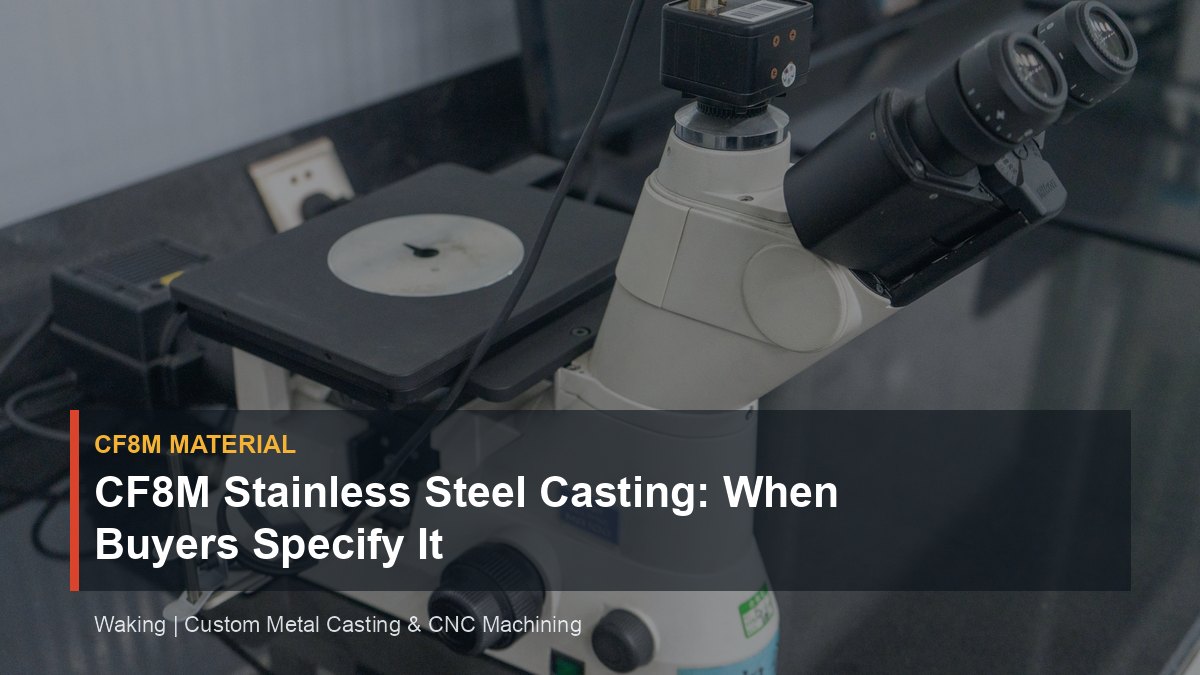
- Metallurgical verification. An inverted metallurgical microscope shows grain structure and lets the metallurgist confirm the material matches the heat number.
- Pressure integrity. For pressure-containing parts, leak testing is non-negotiable. It’s part of the process for valve bodies and similar components. If your part holds pressure, your RFQ should say so, and your supplier should confirm they test for it.
Add mechanical property testing to that list. Pendulum impact testing, including at low temperature, tells you whether the casting will behave in cold service — a real concern for valves and fittings in outdoor and marine installations. A hardness tester and a roundness and profile measuring instrument round out the picture for most CF8M parts.
Before production starts at scale, insist on a first article inspection and sample approval. That’s the point where dimensional, material, and functional checks come together and you sign off on exactly what the factory will repeat. A supplier that offers sample approval as a standard step is a supplier that wants to get it right before spending your money on a full run.
What to Put in Your RFQ for CF8M
At Waking the process runs like this: you send drawings and requirements, engineering does a review and sends a quote, then casting, machining, and delivery follow. That review step is your best chance to get the specification right. Use it.
On the drawing, state the grade exactly: CF8M, not “316 equivalent” and not just “stainless steel.” List the tests the foundry must perform — radiography, pressure or leak testing, dimensional inspection, metallurgical examination. Specify the post-casting work: required machining, passivation, polishing, coating, or heat treatment. If you don’t write it down, don’t assume it’s included.
And share the service conditions. Tell the foundry what the part will carry, at what temperature, and whether chlorides are present. The more context you give, the better the engineering review can serve you. A casting is a promise about what happens inside the part, and you can’t inspect your way into a good material decision. That decision has to happen at the drawing stage.
Finally, ask directly about lead time and minimum order quantity for your specific part. Realistic lead times and a quick response to drawings and quotation are reasonable expectations, but the exact numbers depend on the part’s size, complexity, and quantity. A supplier that asks to see the drawing before quoting a lead time is a supplier who has done this before.
Frequently Asked Questions
What is the practical difference between CF8M and CF8 for a pump or valve casting?
CF8M contains molybdenum and is the cast counterpart of 316, while CF8 is the cast counterpart of 304 without molybdenum. That molybdenum gives CF8M better resistance to pitting and crevice corrosion in chlorides such as saltwater, brine, and bleach. Choose CF8M when the part contacts aggressive or chloride-bearing media; CF8 may be enough in mild conditions.
Does a CF8M casting have the same corrosion performance as wrought 316?
CF8M is effectively the cast counterpart of 316, but cast stainless steels are certified against the ACI cast designation instead of a wrought grade. A foundry will certify the cast part as CF8M, not as 316, even though the corrosion intent is similar. Verify the material certificate and heat traceability to confirm the cast grade.
What internal defects should I worry about in a pressure-containing CF8M casting, and how are they caught?
Shrinkage porosity and micro-porosity can form inside thick sections if solidification is not controlled, and they are not visible from the outside. A qualified supplier should use radiographic examination such as X-ray NDT to detect these internal defects. For pressure-containing parts, leak testing should also be part of the process.
If my drawing just says 'stainless steel', will the foundry know I need CF8M?
No. Writing only “stainless steel” does not tell the foundry whether you need CF8, CF8M, or another grade. Specify the exact cast designation and answer the three key service questions: what is the media, what is the temperature, and does the part hold pressure.
Key Parameters at a Glance
| Parameter | Requirement / Control |
|---|---|
| Material designation | CF8M (ACI cast grade, cast counterpart of 316) |
| Key alloying element | Molybdenum for pitting and crevice corrosion resistance |
| Typical casting process | Silica sol lost wax / investment casting; near-net-shape to reduce machining |
| Heat treatment | Standard in-house process step |
| Internal soundness | X-ray NDT (XTH320) to detect shrinkage porosity and micro-porosity |
| Dimensional verification | CMM (COORD3 and ZEISS SPECTRUM) for critical features |
| Pressure integrity | Leak testing for pressure-containing parts such as valve bodies |
| Traceability | Batch traceability to material certificate and inspection report |
