
When you choose a casting manufacturer for industrial components, the brochure tells you less than the plant audit does. Most buyers start with price. That is a mistake. The criteria that actually separate a good foundry from a marginal one are less visible: how they review your drawing, what happens between casting and delivery, and what they can prove about quality. This article walks through the selection criteria that matter, in the order they matter.
Start With an Engineering Review, Not a Price Quote
The RFQ process is your first and cheapest test of a supplier. A serious foundry reads your drawing before it quotes. It asks about function, pressure requirements, mating surfaces, wall thickness, tolerances, and annual volume. It flags design problems before metal is poured, not after.
At Waking, the process runs in three steps. You send drawings and requirements. The engineering team reviews them and returns a quote. Then casting, machining, and delivery happen. That sequence sounds obvious, but many suppliers skip the middle step. They quote off a drawing without real engineering review, and the problems surface later in scrap bins and delayed shipments.
Send a complete RFQ. Include material spec, finish, inspection requirements, expected volume, and — if the part sees pressure — the test criteria. A quick response to drawings and a realistic quote are fair expectations. If a supplier asks zero questions, treat that as a warning sign, not efficiency.
Match the Casting Process to the Part
Industrial components fall into different material families, and each one points to a different process. Stainless steel parts — valve bodies, impellers, fittings — are typically investment cast. Investment casting, also called lost wax casting, handles complex geometry and gives a good surface finish. Waking runs silica sol investment casting for stainless steel grades 304, 316, CF8, and CF8M, plus carbon steel and alloy steel.
Aluminum parts go a different route. Gravity casting suits simpler shapes with good mechanical properties. Low pressure casting gives better metal density for parts that see stress or pressure. Neither process is universally better. The right fit depends on geometry, volume, and function. A thin-walled housing with fine detail is not automatically an investment casting job. A valve body that needs a leak-tight structure is not automatically a gravity casting job. In practice, most industrial castings fall into familiar shapes: valve bodies and impellers for pumps, housings for automotive and machinery, and structural parts for industrial equipment.
Ask the supplier what they recommend and why. Then check whether they actually run that process in-house. A factory that casts and machines in the same plant — like Waking, which runs investment casting, gravity aluminum, and low pressure aluminum lines — can move a part between processes without finger-pointing. And be honest about annual volume. Casting economics change completely between a prototype run and a production run.
Question Where Machining Happens
The cast part is a blank. The finished part is what you assemble. Between them sit machining and finishing, and this is where many casting supply chains fall apart.
A casting broker — and there are many — may cast in one plant and machine in another. Tolerances get argued about across company boundaries. Parts ship back and forth. Responsibility blurs. When something fails, nobody owns the failure.
Waking is a real foundry, not a trading company, and it keeps machining in-house. The factory runs over 400 CNC machines on site. That is not a marketing number. It is the difference between controlling the machining process and outsourcing it. Casting distortion shows up in machining. Chip loads, clamping, and datum strategy are machining decisions. When the same factory makes both decisions, problems get solved before parts ship, not after a customer rejects them.
Finishing matters the same way. Ask which steps are in-house: deburring, cleaning, polishing, anodizing, plating, passivating, coating, heat treatment. A supplier that subcontracts every finishing step has less control over the final surface than one that does it under its own roof.
Demand Proof of Inspection Capability
Every foundry says it does quality control. Very few can show you the equipment. This is where you separate talk from evidence.
Ask for three things. First, dimensional inspection. A serious supplier has coordinate measuring machines — CMMs — not just calipers and go/no-go gauges. Waking runs COORD3 and ZEISS SPECTRUM CMMs. That matters for castings with tight bore positions or mating faces.
Second, internal defect screening. Casting porosity is the classic hidden failure. Shrinkage voids and gas porosity can survive a dimensional inspection because they are inside the metal. An X-ray NDT system catches them. Waking uses an XTH320 X-ray machine for porosity and shrinkage screening. If your part carries pressure, you need a supplier that can look inside the casting, not just measure the outside. How many foundries can show you that on a plant tour?
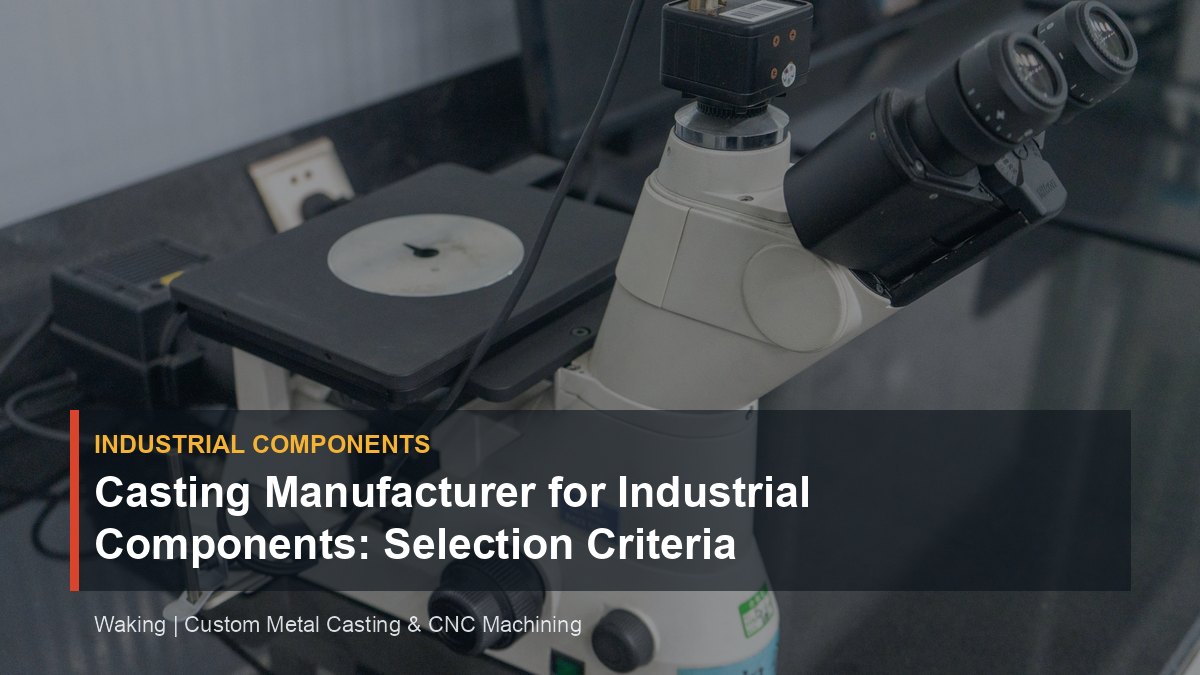
Third, material and mechanical verification. An inverted metallurgical microscope checks the material structure. Hardness testing and roundness or profile measurement verify surface condition and geometry. A pendulum impact tester — including low-temperature impact testing — matters for parts that face cold environments.
And for pressure-containing parts, ask about leak testing. Most articles on pressure testing are written by equipment makers, not foundries. That is a gap. When a foundry builds leak testing into its own process, it tells you more than a certificate ever will. Waking runs leak testing on pressure-containing parts as part of the flow, not as an extra.
Before mass production, a First Article Inspection confirms the casting matches the drawing. Sample approval closes the loop before you commit to a production run. If a supplier cannot show you first-article records, keep looking.
Look for Traceability and Certifications That Match Your Market
ISO 9001 is the baseline. IATF 16949 signals automotive-grade quality management, and Waking holds both. But certificates only matter if there is process behind them.
Traceability is the real test. When a part fails in the field, you need to trace it back to the cast date, the material batch, and the inspection records. Ask whether the factory does batch traceability and issues material certificates together with inspection reports for every shipment. A supplier that cannot trace a bad part will cost you more than the part is worth.
Export experience matters too when you buy from China. Waking has been in Qingdao since 2002 and exports to over 40 regions. That means export packaging and documentation are handled, not improvised. A 70,000 m² production base is scale you can verify on a visit or a video call.
Then confirm the practical items for your specific part: realistic lead time, MOQ, and payment terms. The right answers depend on your casting’s weight, complexity, and volume. Ask the supplier to quote against your drawing instead of accepting a generic response.
The selection criteria come down to five questions.
- Does the supplier review your drawing before quoting?
- Do they run the casting process that fits your part?
- Do they machine and finish in-house, under the same roof?
- Can they prove inspection capability with real equipment, not just brochures?
- Can they trace a batch from melt to shipment?
Ask those five questions, and ask for evidence, not assurances.
Frequently Asked Questions
What exactly should we include in the RFQ for an industrial casting so the foundry can do a real engineering review instead of quoting blindly?
Include the drawing, material spec, finish, inspection requirements, expected annual volume, and if the part sees pressure, the test criteria. A serious foundry will read the drawing and ask about function, pressure requirements, mating surfaces, wall thickness, tolerances, and volume before quoting. If a supplier asks zero questions, treat that as a warning sign, not efficiency.
Our component requires both casting and CNC machining. Why does the article say it matters where the machining happens?
Many casting brokers cast in one plant and machine in another, which leads to tolerance disputes, parts shipping back and forth, and blurred responsibility. When casting and machining are in the same plant, casting distortion, chip loads, clamping, and datum strategy are controlled by one team, so problems are solved before shipment. Waking has more than 400 CNC machines on site.
How can we verify that a foundry can find internal casting defects, not just check outside dimensions?
Ask to see X-ray NDT equipment, not just CMMs. Dimensional inspection cannot see porosity and shrinkage inside the metal, while an X-ray system can. Waking uses an XTH320 X-ray machine for porosity and shrinkage screening, which is especially relevant for pressure-containing parts.
For pressure-containing castings, what proof should we ask for beyond a material certificate?
Ask whether leak testing is embedded in the foundry's normal process rather than offered as an extra. A foundry that builds leak testing into its own flow tells you more than a certificate ever will. Also ask for a First Article Inspection and sample approval before mass production to confirm the casting matches the drawing.
Key Parameters at a Glance
| Selection criterion | What to verify / What Waking provides |
|---|---|
| Engineering review before quote | Drawing review with questions on function, pressure, mating surfaces, wall thickness, tolerances, and annual volume; quote after engineering review, not before |
| In-house casting processes | Silica sol investment casting for stainless steel 304/316/CF8/CF8M, carbon steel, and alloy steel; gravity and low-pressure aluminum casting |
| In-house machining | More than 400 CNC machines on site; casting and machining in the same plant |
| Dimensional inspection | CMMs: COORD3 and ZEISS SPECTRUM |
| Internal defect screening | XTH320 X-ray NDT for porosity and shrinkage screening |
| Material and mechanical verification | Inverted metallurgical microscope, hardness testing, roundness/profile measurement, pendulum impact tester |
| Pressure-part testing | Leak testing built into the normal process; First Article Inspection before mass production |
| Quality system | ISO 9001 and IATF 16949; batch traceability and material certificates |
