Phone:
+86 15005422253
Physical address:
Pingdu City, Qingdao,
Shandong Province, China.

Phone:
+86 15005422253
Physical address:
Pingdu City, Qingdao,
Shandong Province, China.
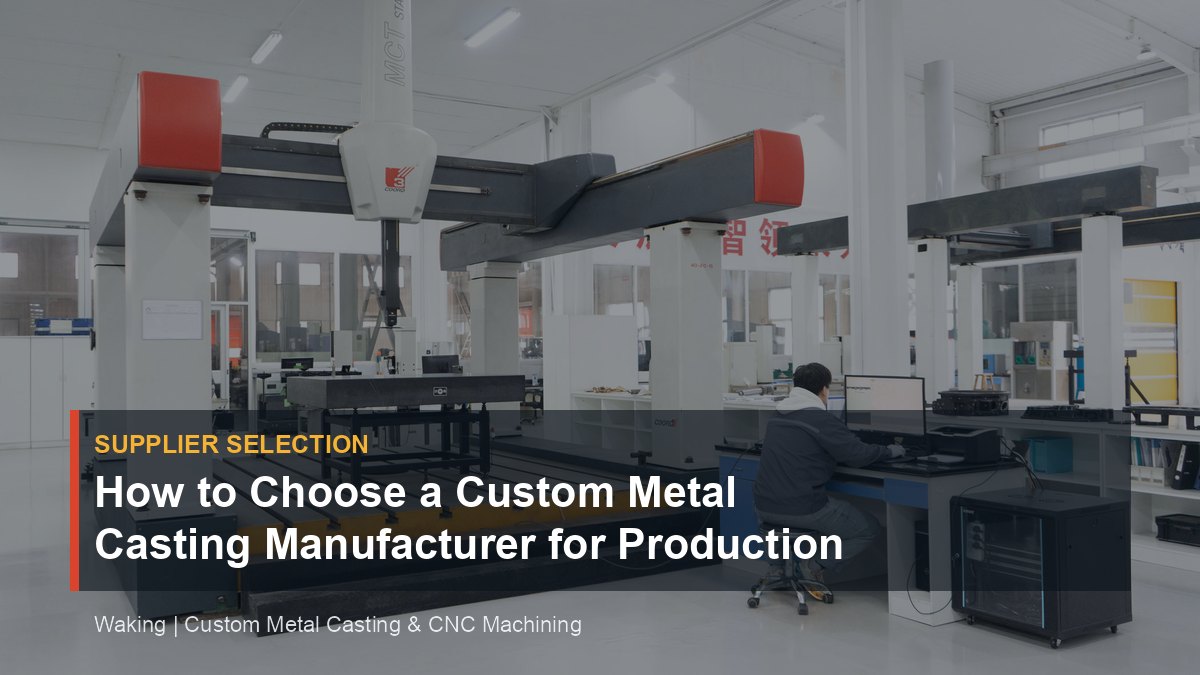
Choose a custom metal casting manufacturer by checking process fit, machining, inspection, documentation, communication and RFQ readiness.
Choosing a casting manufacturer for production parts is a different job than sourcing a one-off prototype. A prototype only has to work once. A production part has to work the same way, batch after batch, month after month. So the real question is not “can they make this part?” It’s “can they make it consistently, verify it properly, and stand behind it when something goes wrong?”
First question to ask any candidate: which steps do you do yourself? Casting in one plant, machining in another, heat treatment somewhere else. Every handoff is a place where tolerances drift and nobody wants to take the blame.
Waking runs casting, CNC machining, heat treatment, surface finishing, and inspection in one factory. The website says it directly: “A Real Casting Factory, Not a Trading Company.” That phrase matters, because the castings market has no shortage of trading companies that forward drawings to factories and collect a margin. You save nothing when a middleman cannot answer a technical question about your part.
Waking was founded in Qingdao in 2002 and operates a 70,000 m² production base with more than 400 CNC machines of its own. It holds ISO 9001 and IATF 16949 certification and exports to 40+ regions. None of those facts guarantee a good part. What they tell you is that the company has enough physical infrastructure to control its own quality. When a machined dimension drifts, the casting engineers and the machining team solve the problem in the same building, from the same drawing, with the same measuring data.
Ask every candidate which steps they handle in-house and which they subcontract. The answers will tell you more than any brochure.
Metal casting is not one process. It’s a family of processes, and the right one depends on material, geometry, and production volume.
Waking runs three processes in-house. Silica sol investment casting — also called lost wax casting — is the route for stainless steel, carbon steel, and alloy steel parts. If corrosion resistance is the requirement, the confirmed stainless grades are 304, 316, CF8, and CF8M. The first two are wrought grades you would typically machine from bar stock; CF8 and CF8M are their cast equivalents, specified when the part shape only makes sense as a casting. Valve bodies and impellers are the classic examples.
For aluminum alloy parts, the in-house routes are low pressure casting and gravity casting. These are the workhorses for automotive housings and industrial machinery components, where weight, thermal performance, and complex enclosed shapes matter more than raw strength.
Don’t pick the process before you send the drawing. The right sequence is to send drawings and requirements first, then let an engineering review recommend the process and quote accordingly. That is exactly Waking’s standard flow: send drawings, engineering review and quote, then casting, machining, and delivery. If the review comes back with questions about wall thickness, draft angles, or gate locations, that is a good sign. If the quote arrives with no questions at all, be suspicious. Either they did not read your drawing, or they do not care enough to flag problems.
Every casting manufacturer claims to have quality control. Few can list the equipment behind the claim. The difference matters because casting defects are not always visible.
Porosity and shrinkage form inside the metal. You cannot see them on a surface check, and they often do not show up until the part is under pressure or load. That is what X-ray inspection is for. Waking runs an XTH320 X-ray NDT system to screen for internal defects like porosity and shrinkage. If you are buying valve bodies, pump parts, or anything that must hold pressure, this capability is not a luxury. It’s the difference between finding a defect in the foundry and finding it in the field.
The rest of the inspection lab should be just as concrete. Waking has two coordinate measuring machines — a COORD3 and a ZEISS SPECTRUM — for dimensional verification, plus roundness and profile measuring equipment, hardness testers, a pendulum impact tester with low-temperature testing capability, and an inverted metallurgical microscope for checking the material’s internal structure. A portable measuring arm keeps inspection close to the part. If some of that equipment is unfamiliar, fine. The point is simple: a manufacturer who owns this equipment can prove the part meets the drawing. One who does not can only tell you that it should.
For pressure-containing parts, ask specifically how leak testing is handled. Waking performs leak testing on pressure-containing parts in-house and treats it as a standard step, not a special request. That control matters because a casting can pass dimensional checks and still leak through micro-porosity.
The last piece is traceability. Production parts can fail years after you buy them, and you need to trace the failure back to its source. Waking issues batch traceability — material certificates and inspection reports together — so every part connects back to its melt and its inspection record.
The engineering review is the best window into how a casting manufacturer thinks. Use it deliberately.
Send a drawing that exercises their judgment: a thin wall, a tight tolerance, an awkward gate location. See what comes back. A sharp engineer will flag the risk areas and propose solutions. They will also lay out the sample approval process up front — what you sign off before production starts, what inspection data comes with the sample, and what happens if the sample meets the drawing dimensions but fails in function.
Waking’s process includes first article inspection and a formal sample approval step before full production. That is the correct order: prove the parts, then run the volume. If a supplier suggests jumping straight into production without a sample approval step, walk away. You are buying a relationship, not just a casting, and that relationship needs a checkpoint before money goes into tooling and production runs.
Response speed is another signal. A quick response to drawings and quotation is a reasonable expectation, and it usually predicts how the rest of the relationship will go. Slow quoting tends to mean slow problem-solving later. And do not stop at email. Ask to see the inspection lab, or request photos of the CMM in use. A real factory can show you its equipment. A trading company will have to explain why it cannot.
One honest statement: confirm the numbers with the supplier for your specific part. Exact lead times and minimum order quantities depend on part size, material, complexity, and the foundry’s current schedule. Any supplier who quotes a firm lead time or MOQ without seeing your drawing is guessing.
What you want is a realistic lead time, not a heroic one. Fast quotes are easy; fast delivery of good parts is hard. Waking’s position is straightforward: realistic lead times, quick response to drawings, and honest expectations on volumes. When you get a committed schedule, hold the supplier to it — and ask what they do internally when a batch falls behind.
For production parts, also ask about repeat orders. Will the tooling be maintained and stored between orders? Are material certificates reissued with every batch? Do repeat orders run through the same inspection plan? The answers determine whether batch fifty, eighteen months from now, is as good as batch one.
One more thing worth checking: whether the supplier treats your drawing as a static document or a living one. Production parts change. A fastener gets revised, a pressure rating gets tightened, a customer adds a requirement. A good casting manufacturer will flag when those changes affect castability, and will quote the change honestly instead of absorbing it silently and hoping for the best.